


There is a condition affecting more than 50 million Indians over the age of 60 that most families have never heard the name of. Sarcopenia — the progressive, generalised loss of skeletal muscle mass and function that comes with ageing — sits somewhere between invisible and inevitable in the Indian healthcare conversation. It is not dramatic enough to generate urgency. It builds slowly. And then, one afternoon, a parent who was managing fine falls in the bathroom, or cannot get out of a chair unassisted, or comes home from a two-week illness as a fundamentally different, more fragile person than the one who went in.
By that point, the sarcopenia has usually been developing for years.

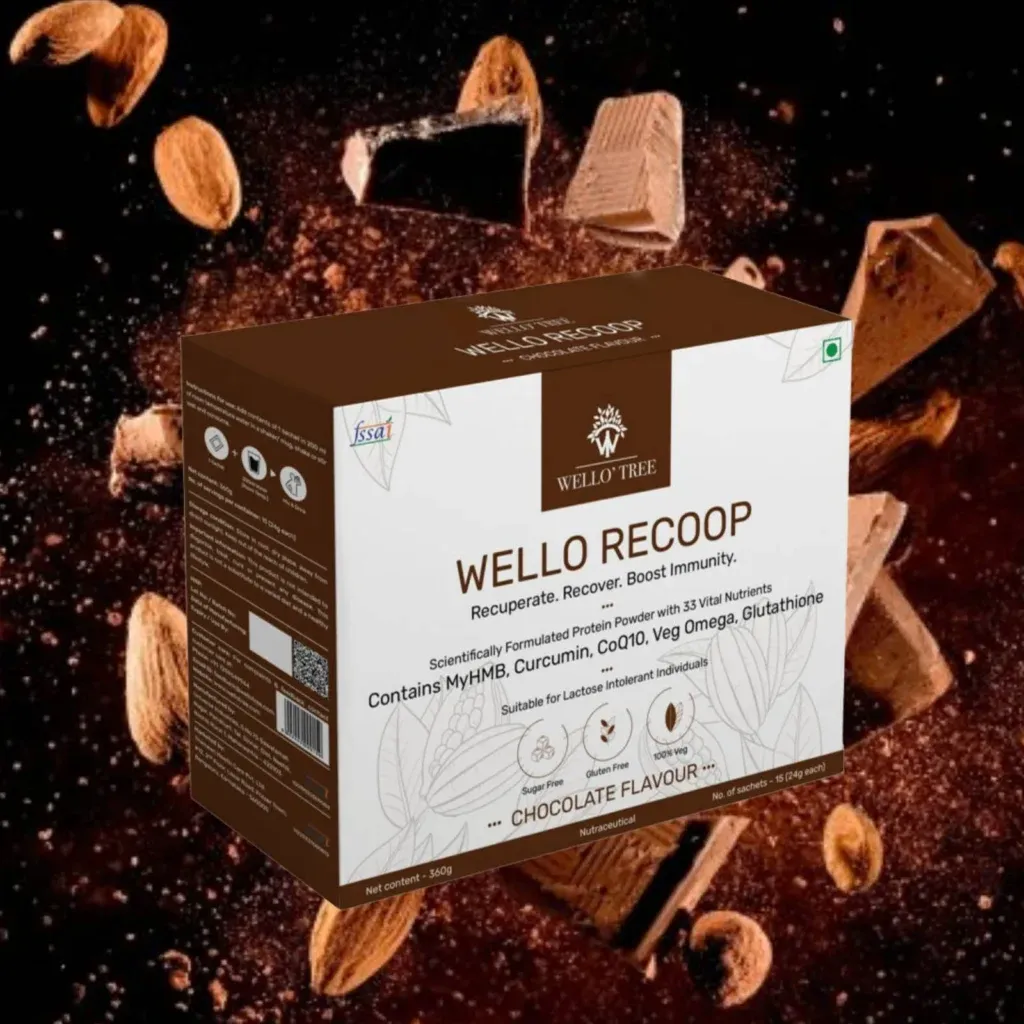
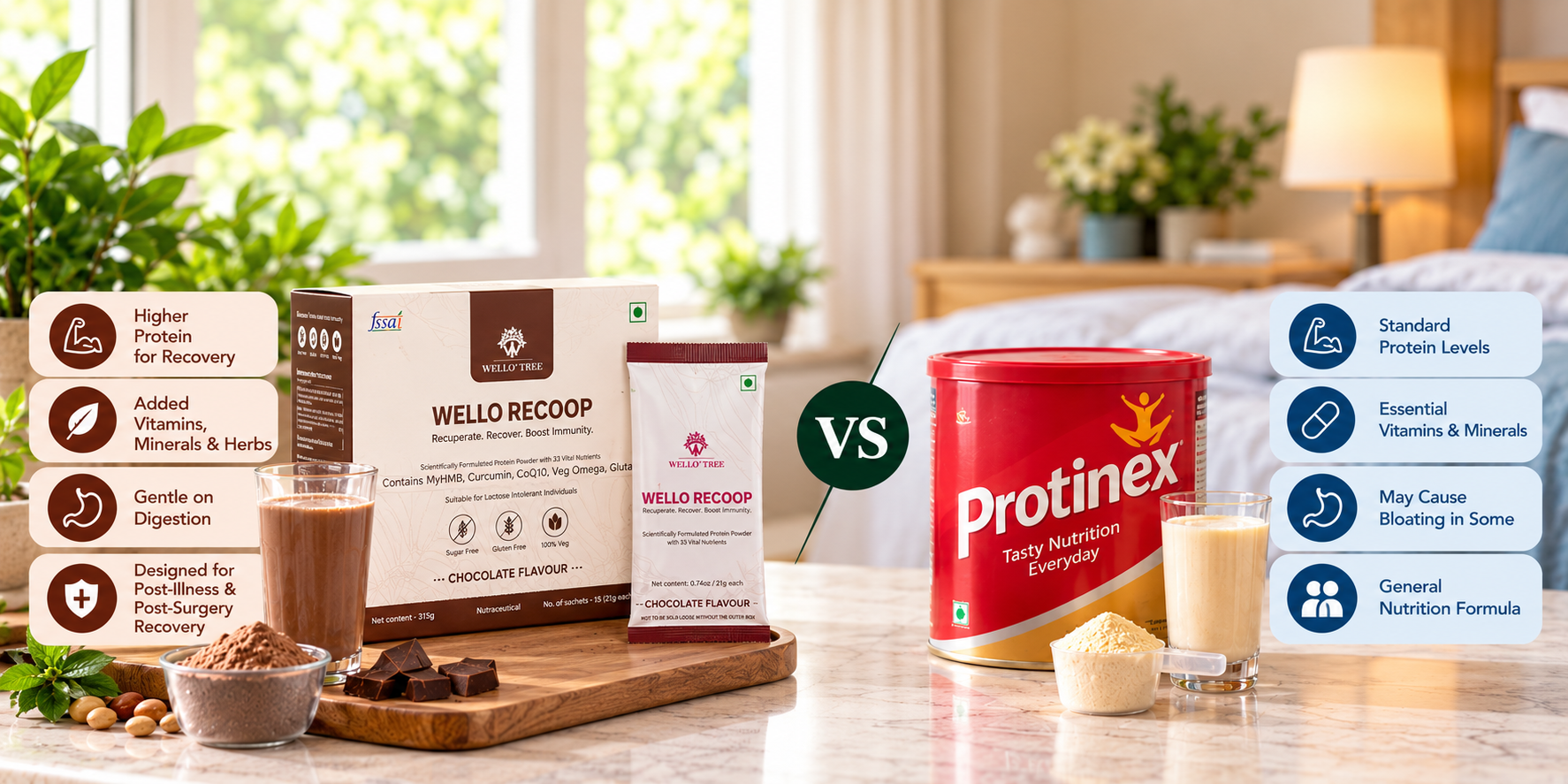
Wello Recoop is a diabetic-friendly, sugar-free recovery protein formulated with whey, pea, and brown rice protein plus HMB, CoQ10, curcumin, and probiotics.
What Sarcopenia Actually Is
Sarcopenia is not just being thin or looking weak. It is the loss of skeletal muscle mass below a threshold that impairs physical function — and with it, the parallel loss of strength and performance. The AWGS (Asian Working Group for Sarcopenia) criteria are more relevant for Indian patients than European cutoffs, because body composition differs across populations. By Asian criteria, sarcopenia prevalence in community-dwelling elderly Indians is estimated between 20-40%, depending on the population and the measurement method.
That is a staggering number. It means that in any extended family gathering with several members over 65, statistically, at least one or two of them meet the clinical criteria for this condition. And no one in that room knows it.
What makes sarcopenia clinically serious is not just the muscle loss itself but its downstream effects. Falls. Fractures. Loss of balance. Reduced ability to recover from illness or surgery. Increased insulin resistance. Greater susceptibility to fatigue. And perhaps most insidiously, a reduced ability to withstand the metabolic demands of any acute health event — the hospitalisation for pneumonia, the hip replacement, the cardiac event — that forces the body to draw on reserves it no longer has.
Why Indian Elders Are Particularly Vulnerable
The vegetarian Indian diet, for all its genuine merits, has a structural weakness in the context of ageing: protein quality and quantity. Not all plant proteins are created equal in terms of amino acid completeness, and the leucine content of traditional Indian vegetarian foods — which drives muscle protein synthesis — is lower than in animal-based protein sources. An elderly person eating two modest servings of dal per day and a small amount of paneer or curd is likely getting 40-55 grams of protein, when the clinical requirement for their age and weight may be 70-90 grams.
This gap, sustained over years, is one reason sarcopenia prevalence may be higher in vegetarian elderly populations than in those consuming more diverse protein sources.
Physical activity patterns in Indian elderly also contribute. Traditional Indian life involved a great deal of incidental physical activity — walking, squatting, manual kitchen work, agricultural and domestic labour. As urban living and household help have reduced these activities, and as sedentary behaviour has increased, the stimulus for maintaining muscle has reduced. Muscle, unlike fat, has a “use it or lose it” biology that is merciless with sustained inactivity.
I saw this pattern in a 74-year-old retired teacher from Coimbatore who came in for a nutrition consultation after a fall. She was eating adequately by caloric measure — rice, sambar, vegetables, a small amount of curd. But her protein intake was around 38 grams per day. She had lost approximately 7 kg of body weight over four years, much of it from lean mass. Her handgrip strength was below the age-adjusted threshold. She had classic sarcopenia, and her diet, while traditional and nutritious in many ways, had left her muscle reservoir essentially empty.
The Diagnostic Gap
Sarcopenia is not routinely screened for in Indian clinical practice. There is no blood test for it. DEXA scanning (which measures body composition accurately) is not widely available or routinely ordered. Grip strength measurement, one of the simplest and most validated proxies for sarcopenia risk, is not part of most geriatric outpatient assessments in India.
What this means practically is that sarcopenia is almost never caught early. It is usually identified — if at all — after a fall, after a hospitalisation, after a family notices that an elderly parent “suddenly seems weaker.” The suddenly is an illusion. The decline has been incremental and silent for years.
What Actually Helps: Nutrition Side
The clinical evidence for sarcopenia prevention and management converges on two interventions: protein intake and resistance exercise. In practice, the combination is far more effective than either alone. But for many elderly patients, especially those who are already frail, the nutrition side is where intervention has to start — because it is both more accessible and more immediately modifiable.
Target protein intake: 1.0-1.2 g/kg/day for prevention in healthy elderly; 1.2-1.5 g/kg/day for those already showing signs of sarcopenia or who have had recent illness. Leucine content matters — ensuring at least one high-leucine source (whey protein, egg, or a leucine-enriched protein supplement) at each meal is supported by multiple sarcopenia intervention trials.
Vitamin D status is consistently low in elderly Indians despite abundant sunlight — indoor living, covered clothing, and reduced cutaneous synthesis with age all contribute. Vitamin D is critically involved in muscle function, not just bone health. Supplementation should be guided by 25-OH vitamin D levels and clinical assessment.
Calcium for bone health (since sarcopenia and osteoporosis frequently co-exist). Omega-3 fatty acids, which have shown modest but consistent benefit in reducing muscle protein breakdown in several studies. And zinc, which is involved in protein synthesis pathways and is commonly deficient in elderly Indians. Nutrition Supplements for Elderly Indians
What Actually Helps: Activity Side
Resistance exercise — not cardio, not yoga alone, but exercises that load the muscles — is the most effective stimulus for preserving and rebuilding muscle mass in the elderly. This does not require a gym. Seated leg exercises, resistance band training, stair climbing, and even carrying light weights while walking are all relevant. The challenge is that frail elderly patients need physiotherapy guidance to do this safely, particularly after a fall or illness.
The combination of adequate protein and even modest resistance exercise has a synergistic effect that neither intervention achieves alone. In elderly patients, post-exercise protein intake is particularly important: the anabolic window following muscle loading is when protein intake has the greatest impact on muscle synthesis.

Available in Chocolate and Mango flavours
FAQs
Skeletal muscle mass typically peaks in the mid-30s and begins declining from around 40 onwards, with the rate of decline accelerating after 60. Clinically significant sarcopenia — where muscle loss begins to impair function and independence — is most commonly diagnosed in adults over 65, though the groundwork has often been laid for decades before that.
Warning signs include reduced grip strength (difficulty opening jars, weaker handshake), slower walking pace, difficulty rising from a chair without using arms, unexplained weight loss over months, and a history of one or more falls. A formal diagnosis requires clinical assessment of muscle mass and function, ideally with grip strength measurement and, if available, DEXA scanning.
Partially, yes — particularly if caught before it is severe. Adequate protein intake combined with progressive resistance exercise can rebuild meaningful muscle mass even in adults in their 70s and 80s. The response is slower than in younger people, and the anabolic sensitivity to protein is reduced, meaning higher protein intakes are needed to achieve the same effect. But reversal is possible with sustained effort.
A well-planned vegetarian diet can support muscle health, but it requires deliberate attention to protein quantity and quality. Many elderly Indians eating traditional vegetarian diets fall short of the protein targets needed to prevent sarcopenia. Ensuring leucine-rich sources (paneer, curd, soya, or a whey-containing supplement) at each meal, alongside adequate vitamin D and omega-3s, is essential.
ICMR guidelines recommend approximately 1.0 g of protein per kilogram of body weight per day for adults. For elderly individuals, particularly those at risk of or already showing sarcopenia, many clinical nutrition bodies recommend a higher intake of 1.2-1.5 g/kg/day, as the efficiency of protein utilisation declines with age.