





Patients and their families tend to think of recovery as a straight line upward. You leave the hospital, you rest, you gradually eat better, and over the next few months you return to normal. That is roughly the trajectory — but the distribution along that line is nothing like people expect.
The first two weeks at home after any significant hospitalisation are not like the weeks that follow. Physiologically, they are a completely different environment. The body is at its most catabolic, appetite is at its lowest, and yet the nutritional and physical inputs during this window have a disproportionate effect on how the next six months look.
I have operated on hundreds of patients. What differentiates the ones who are back on a morning walk at two months from the ones who are still struggling at the six-month mark is rarely the surgery itself. It is almost always what happened in those first two weeks at home.

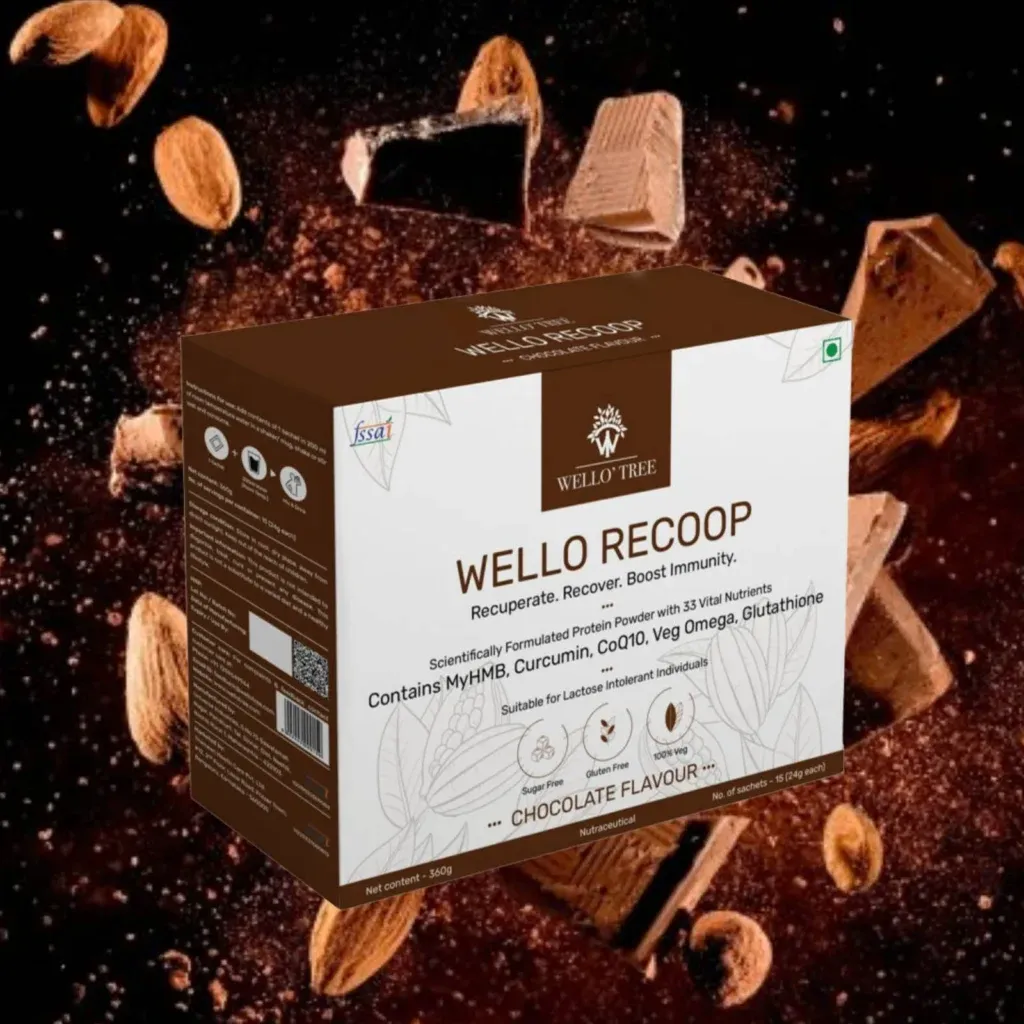
Wello Recoop is a diabetic-friendly, sugar-free recovery protein formulated with whey, pea, and brown rice protein plus HMB, CoQ10, curcumin, and probiotics.
What the Body Is Actually Doing After You Leave the Hospital
Hospitalisation itself triggers muscle loss — not just the surgery or illness, but the bed rest, the disruption to normal meals, the medications, the stress response. A patient admitted for a week-long hospitalisation for cardiac intervention can lose muscle mass equivalent to several months of normal ageing during that single week. Studies on bed-rest deconditioning show measurable reductions in leg muscle strength within 72 hours.
The catabolic process does not stop at discharge. It continues at home, typically for one to two weeks, sometimes longer depending on the severity of the original event. During this time the body is still in a state of heightened protein breakdown — burning through muscle tissue to supply amino acids for immune function, wound healing, and organ repair. The signals that would normally promote muscle building (anabolic signals like insulin-like growth factor and growth hormone) are relatively suppressed.
What this means in practice: the patient at home in week one needs more protein than they did before admission, is eating less than they normally would, and is moving less than they need to in order to reverse the muscle loss. That is a three-way mismatch between need, intake, and physical activity.
Why Strength Does Not Come Back the Way You Expect
Here is what I tell every patient before discharge: strength comes back in stages, and the stages do not feel equal. In the first two weeks, you may feel like you are getting worse rather than better. Energy is lower, appetite is still suppressed, and the effort of simple tasks is disproportionate to what you remember it being. This is normal. It is not a sign that something went wrong. It is the catabolic phase completing itself.
Between roughly weeks two and six, for most patients, there is a visible turn. Appetite starts to return. Energy feels more consistent through the day. The body begins to shift from breakdown to rebuild — provided it has the raw materials to do so.
The problem is that many patients and families interpret that first two-week plateau as the new normal. They reduce activity expectations permanently, they keep the diet light because “digestion is still recovering,” and by the time the body was ready to rebuild, the nutritional and physical scaffolding was not in place to support it.
The Nutritional Window: What Matters and When
Protein is the single most important nutritional variable in the early recovery period. But timing and distribution matter as much as total quantity.
The anabolic threshold for muscle protein synthesis is approximately 20 to 40 grams of high-quality protein per eating occasion for adults over 50. Below that threshold, the protein you consume goes primarily to energy and immune support rather than muscle rebuilding. Above that threshold in a single meal, the surplus is not meaningfully utilised for muscle synthesis — it is oxidised.
This is why “eating more” does not solve the problem if it means eating one large protein-dense meal and three small ones. The protein needs to be distributed across three to four eating occasions throughout the day. Practically, for an Indian family, this means looking at every meal and snack as a protein opportunity rather than treating protein as something that happens at dinner with the dal.
One patient of mine — a 67-year-old retired schoolteacher who came through a triple bypass — was eating exactly this way at the two-week follow-up. Her breakfast was poha with minimal protein, lunch was reasonable with dal and curd, and dinner was the main protein meal. Her mid-morning and evening tea had biscuits. When we redistributed her protein intake — adding a protein-enriched supplement at breakfast and including a small protein source at each tea time — her energy at the four-week visit was markedly different. She made a point of telling me at the six-week follow-up that she had walked to the corner shop unassisted for the first time.
The Physical Window: Moving Before You Feel Ready
The second critical input in the first two weeks is movement. Not exercise — movement. The distinction matters because families often take “rest” to mean absolute bed rest, which is one of the worst things for a patient in the early recovery phase.
Gentle ambulation — walking slowly around the house, rising from a chair and sitting back down several times, standing at the kitchen counter rather than sitting — all of this preserves the functional capacity of muscle in ways that bed rest cannot. It is not about exertion. It is about neuromuscular signalling: the body needs to receive the message that these muscles are required.
In older patients, the ability to rise from a chair without using hands is one of the single best predictors of medium-term recovery outcomes. I use it as a clinical marker. A patient who cannot do this at the three-week follow-up is at higher risk of extended functional decline than one who can. The intervention is not complicated: practice getting up from a low chair, multiple times a day, with family support if needed.
What Families Get Wrong in the First Two Weeks
The most common error I see from families is overcorrecting on gentleness. They mean well — they are frightened by what the patient has been through. So they enforce bed rest past the point where it helps. They prepare soft, easy-to-digest foods for weeks when the patient is physiologically ready for normal eating. They discourage walking “until you are stronger.”
The cruel irony is that all of this keeps the patient weaker for longer. Strength is not restored by waiting. It is restored by loading — nutritionally and physically — at the right time, in the right amount.
The families that navigate this best are the ones who treat the first two weeks as the highest-stakes nutritional and physical rehabilitation period of the entire recovery, rather than a passive waiting phase. They are tracking protein intake, they are encouraging movement several times a day, and they are using supplements like Wello Recoop not as a shortcut but as a tool to ensure that when the body is ready to rebuild, it actually has the building blocks available.
A Recovery Framework for the First Six Weeks
Weeks one to two: prioritise protein at every eating occasion, use a quality recovery supplement to fill appetite-driven gaps, encourage gentle movement three to four times daily, avoid enforced bed rest. Expect low energy and slow progress.
Weeks three to four: appetite should be returning. Increase food volume and variety. Continue supplementation until dietary protein consistently meets targets. Increase ambulation — short outdoor walks if cleared by the physician.
Weeks five to six: this is when real strength gains become possible for most patients. Resistance-type activity — chair exercises, light resistance bands — if medically appropriate. Protein targets maintained. The gains made in this window compound over the following months.
None of this is complicated. But it requires families to be briefed on it at discharge rather than left to figure it out from generic advice to “eat well and rest.” Protein Requirements After Surgery

Available in Chocolate and Mango flavours
FAQs
This varies by age, the nature of the illness or surgery, and how well the nutritional and physical recovery is managed. For most adults, meaningful strength recovery begins in weeks three to four, with significant improvement visible by weeks eight to twelve. Elderly patients and those with poor early nutrition may take considerably longer.
Yes. The catabolic process continues for one to two weeks after discharge. The body is still in breakdown mode, and fatigue and weakness during this period are expected. The key is to support the body nutritionally during this window so that when the anabolic shift occurs, it has what it needs.
Protein is the priority, distributed across three to four eating occasions per day. Good sources for Indian vegetarian patients include dal, paneer, curd, eggs if dietary practice allows, and a quality recovery protein supplement. Total daily protein should aim for at least 1.2 grams per kilogram of body weight.
Absolute bed rest beyond what is medically required actually delays recovery by accelerating muscle loss. Gentle ambulation — walking around the house, sitting and standing exercises — should begin as early as medically cleared. Movement, not vigorous exercise, is the goal in the early weeks.
Bed rest, reduced food intake, the metabolic stress response to illness or surgery, and medications all contribute to accelerated muscle protein breakdown during hospitalisation. Studies show measurable strength reductions within 72 hours of bed rest, even in otherwise healthy people.