



Every week I discharge patients who have come through significant surgery and the one thing I notice consistently is what the discharge sheet does not contain. It lists the medications, the wound care instructions, the follow-up dates. It almost never gives the patient a protein number.
This is not a small omission. The body’s demand for protein in the weeks following major surgery is substantially higher than normal — sometimes double the standard adult requirement. And in my clinical experience, most patients go home to diets that meet perhaps half of what they actually need.

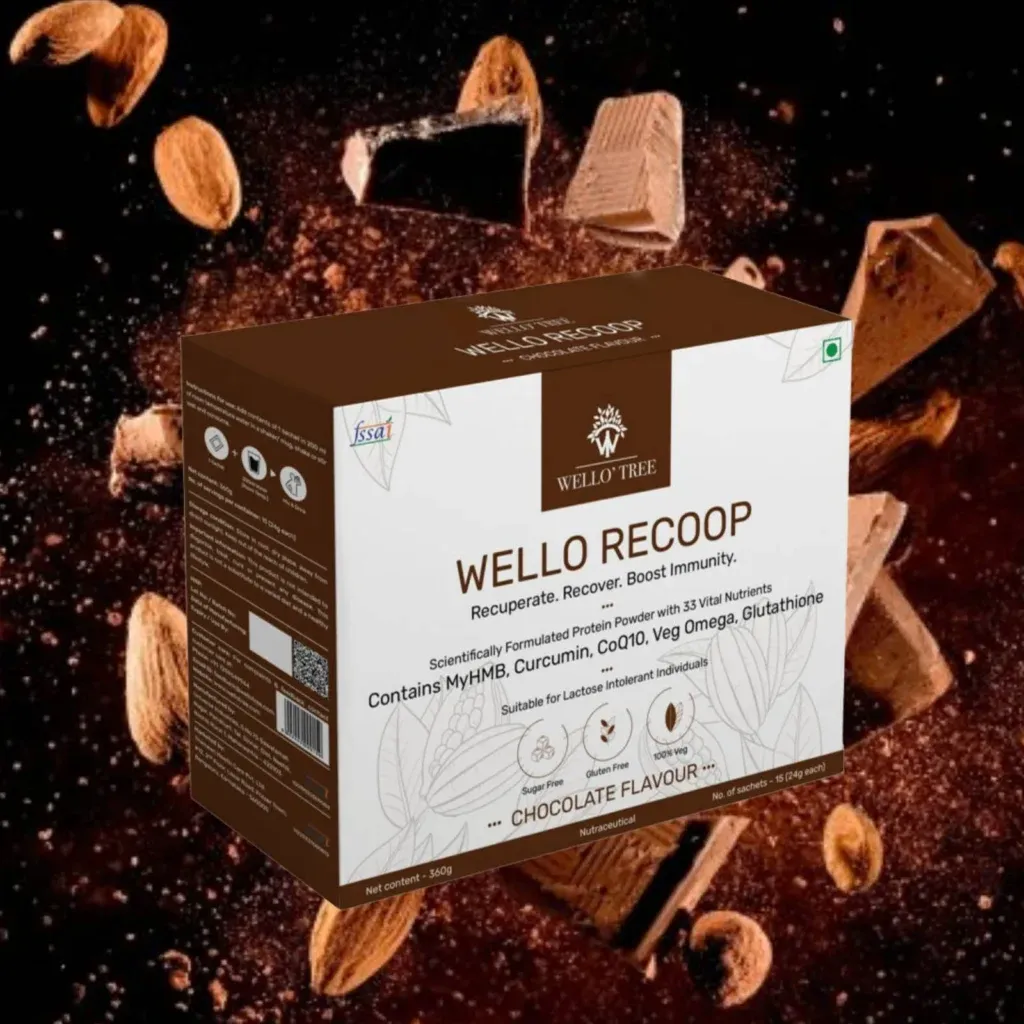
Wello Recoop is a diabetic-friendly, sugar-free recovery protein formulated with whey, pea, and brown rice protein plus HMB, CoQ10, curcumin, and probiotics.
What Happens to Protein During Surgical Recovery
Surgery triggers a metabolic response that most patients are not prepared for. The body enters what physiologists call a catabolic state — it begins breaking down muscle tissue to fuel repair. This is a designed response. It means your muscles are being used as raw material, and the only way to slow that process is to give the body an adequate supply of dietary protein.
In the first 24 to 72 hours after surgery, nitrogen losses from the body can be substantial. The larger the surgery, the greater the demand.
What compounds the problem is appetite. After surgery, most patients eat poorly for the first week or two at home. Nausea, fatigue, the psychological residue of the hospital — all of it suppresses food intake precisely at the moment when protein demand is at its highest.
What Does the Evidence Actually Say?
The European Society for Clinical Nutrition and Metabolism (ESPEN) recommends protein intakes of 1.5 to 2.0 grams per kilogram of body weight per day for surgical patients during recovery. For a 60 kg Indian adult, that translates to 90 to 120 grams of protein daily. The Indian Council of Medical Research (ICMR) RDA for a healthy adult is 0.8 grams per kilogram — about 48 grams for the same person. The gap between those two numbers is the gap between maintenance and recovery.
Post-surgical patients are not healthy adults. They are in a state of accelerated catabolism, active wound healing, and often immune stress.
A 2018 study published in Clinical Nutrition found that patients who met recommended protein targets post-operatively had significantly shorter functional recovery times and lower rates of surgical site complications. The data is not ambiguous.
Where the Average Indian Vegetarian Diet Falls Short
I want to be precise here, because a common response to this conversation is: “I eat dal every day.” That is not wrong, but it is not sufficient.
A standard lunch of two rotis with a katori of dal and a small serving of sabzi typically provides 12 to 15 grams of protein. A full day of eating that pattern — three reasonable meals — might deliver 45 to 55 grams of protein total. For a resting healthy adult, that is borderline adequate. For someone three weeks post-surgery, it is less than half of what they need.
The structural challenge with Indian vegetarian diets is not ingredient quality — dal, paneer, curd, and soy are genuinely good protein sources. The challenge is volume and appetite. A recovering patient who has had, say, a hip replacement may be eating one proper meal a day because everything else feels like effort. Asking them to double their protein intake through food alone is, in practice, not realistic for most of the first month.
This is where supplemental protein becomes clinically useful — not as a replacement for food, but as a gap-filler during a window when the gap matters.
High-Value Protein Sources in the Indian Diet
For vegetarian patients who are eating reasonably well, the priority should be protein density per serve. Paneer, for instance, gives approximately 18 to 20 grams per 100 grams and is well-tolerated after most surgeries. Curd at 4 to 5 grams per 100 ml is lower density but easy to consume in volume. Soy products — tofu, soy chunks — are underused in many households but offer an excellent amino acid profile.
Eggs are particularly valuable for patients who consume them, given their complete amino acid profile and digestibility. For the elderly patient recovering from joint surgery, two eggs at breakfast alone covers about 12 grams, with better amino acid quality than an equivalent protein amount from most plant sources.
What most patients do not realise is that protein quality — specifically the leucine content, which is the key trigger for muscle protein synthesis — matters as much as total protein grams. Leucine is higher in dairy, egg, and whey than in most plant sources. This is why a mixed protein strategy, rather than a single source, is preferable for post-surgical patients.
The Window That Most Families Miss
The first four to six weeks after surgery represent a critical window. Muscle that is lost during this period due to inactivity and inadequate nutrition is significantly harder to regain in patients over 50 than in younger adults. The rate of muscle protein synthesis declines with age, which means that elderly patients have both greater losses and a reduced capacity to rebuild.
I routinely see patients who present at three-month follow-up unable to climb stairs, not because of surgical complications, but because they returned home to an inadequate diet during those first weeks. When I ask what they were eating, the answer is almost always light — khichdi, sooji, fruit. Gentle, digestible foods that are virtually protein-free.
The clinical guidance on post-surgical diet needs to change. Patients and families need a number — not a list of “good foods,” but an actual protein target, communicated clearly at discharge.
Practical Guidance for Post-Surgical Protein Intake
As a starting framework for adults post-surgery, I would suggest the following approach — always discussed with the treating physician and dietitian first, since individual needs vary by surgery type, kidney function, and comorbidities.
Target at minimum 1.2 grams of protein per kilogram of body weight per day in the early recovery period, working toward 1.5 grams if appetite and kidney function allow. Distribute protein across three to four eating occasions rather than attempting to load it all at once — the body can only utilise approximately 25 to 40 grams per meal for muscle protein synthesis.
Prioritise leucine-rich sources: dairy (especially paneer and curd), eggs if dietary practice allows, and quality protein supplements where whole food intake is insufficient. Wello Recoop is one such option — formulated specifically for recovery contexts with whey isolate, pea, and brown rice protein alongside HMB, which has clinical evidence for muscle preservation during catabolic states. It is not a medicine; it is a nutritional tool for a specific clinical window. [Internal link: /blog/hmb-supplement-benefits]
Finally, do not wait until the patient has lost visible muscle mass. By the time the signs are obvious — the hollowed-out shoulders, the difficulty rising from a chair — the deficit has been building for weeks. Start the protein conversation on discharge day. HMB Supplement Benefits

Available in Chocolate and Mango flavours
FAQs
The clinical recommendation for most surgical patients during recovery is 1.5 to 2.0 grams of protein per kilogram of body weight per day, significantly higher than the general adult recommendation. A 60 kg adult recovering from major surgery may need 90 to 120 grams of protein daily. This should be discussed with the treating team based on surgery type and individual factors.
A typical Indian vegetarian meal provides approximately 12 to 15 grams of protein per meal. For a full recovery day target of 90 grams or more, this requires significantly more volume than most patients eat — particularly when post-surgical appetite is low. A protein supplement during the recovery period helps bridge the gap.
For most patients without kidney disease, quality whey protein is safe and well-tolerated after surgery. Whey isolate in particular is low in lactose and digests quickly. Patients with compromised renal function should consult their nephrologist before increasing protein significantly.
As soon as oral intake is medically cleared, which for most elective surgeries is within 24 to 48 hours. The earlier the protein gap is addressed, the less muscle loss accumulates during the critical recovery window.
Yes. Protein — specifically the amino acids that make up it — provides the raw materials for collagen synthesis, immune function, and tissue repair. Adequate protein intake is associated with faster wound healing and lower rates of surgical site complications.