



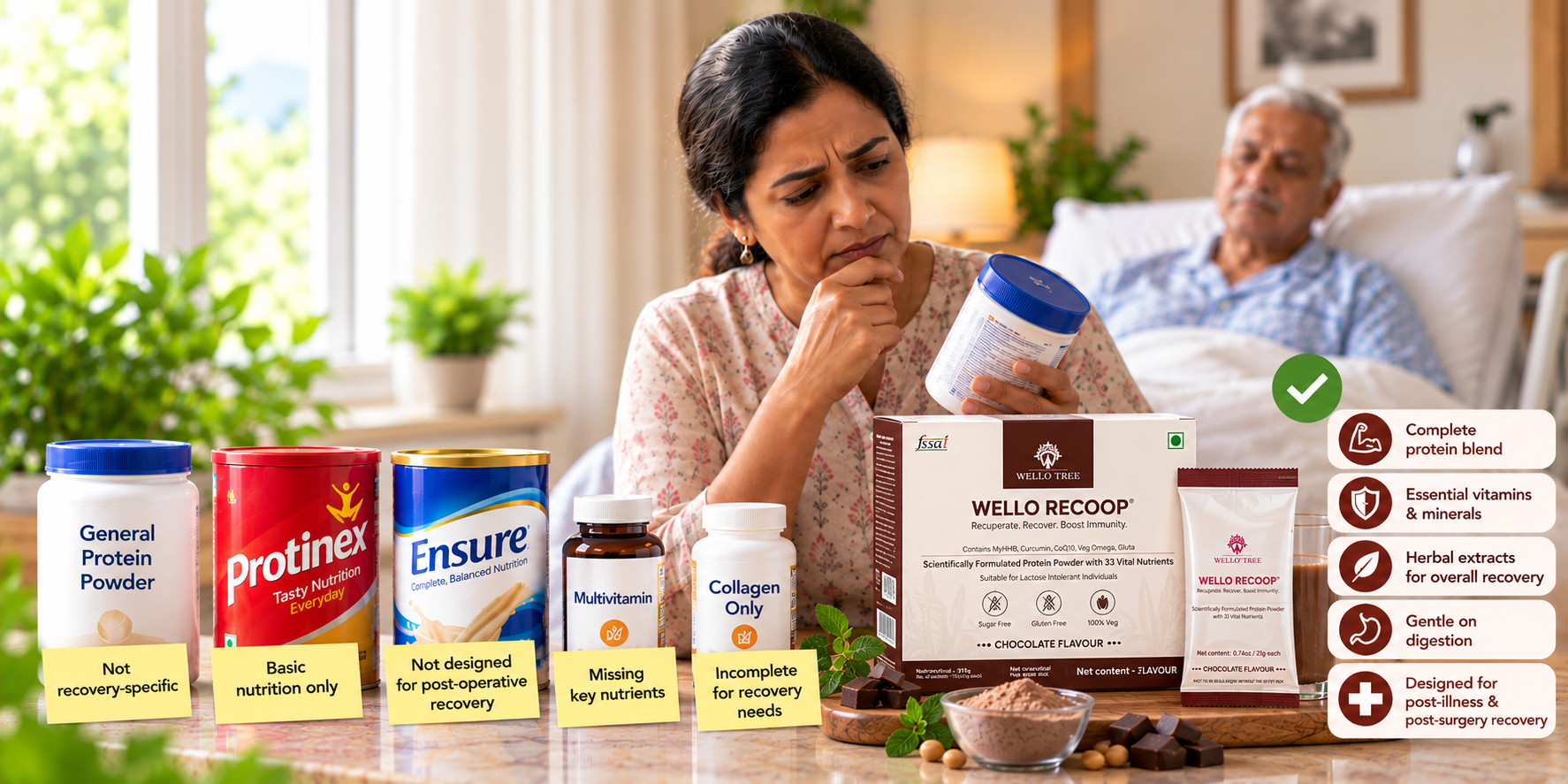
The pharmacy shelf, or the modern equivalent — the health product section of your e-commerce app — offers a striking array of options for the adult child who has decided their ageing parent needs nutritional support. Ensure, Protinex, Complan for adults, Horlicks for adults. All of them are marketed at approximately the same audience. None of them are identical in composition, and the differences matter more than most buyers understand when they pick one up.
I want to walk through what those differences actually are, because the question “which supplement should I buy for my elderly parent” is worth answering carefully rather than defaulting to whichever has the most prominent pharmacy display.

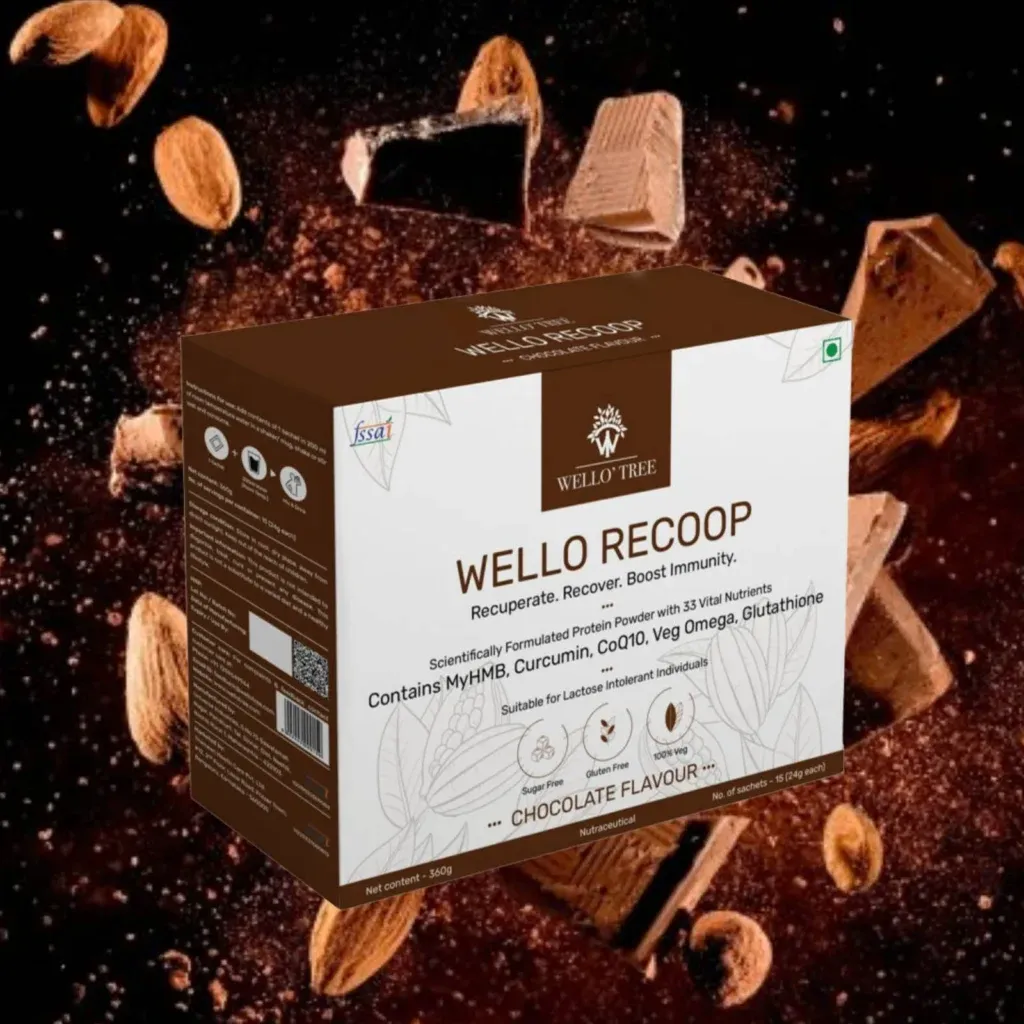
Wello Recoop is a diabetic-friendly, sugar-free recovery protein formulated with whey, pea, and brown rice protein plus HMB, CoQ10, curcumin, and probiotics.
What the Elderly Body Specifically Needs (and What Most Supplements Emphasise)
The primary nutritional challenge of elderly adults in the context of muscle health is protein adequacy and quality, not caloric adequacy alone. Many commercial nutritional supplements are formulated primarily around calories — because the stated goal of “nutritional support” has historically been built around preventing undernutrition and weight loss in clinical settings.
This is appropriate in some clinical contexts, particularly in patients who are severely malnourished or who need to gain weight. But for an ambulatory 70-year-old with reasonable body weight who is beginning to lose muscle, show early signs of weakness, or struggling to recover from an illness, the calorie-first formulation is not the right answer. The calorie-first supplement provides energy that the body may already have enough of, while the protein and specific micronutrients needed for muscle synthesis remain inadequate.
Look at the typical composition of Ensure or similar caloric supplement products. A serving provides 220-250 kcal, with 8-9 grams of protein, and a significant portion of those calories coming from sugars and carbohydrates. For weight maintenance in a clinical setting, this works. For muscle preservation in an elderly person at home, the protein contribution per calorie is low, and the sugar content is a concern for the large proportion of elderly Indians who have or are at risk of Type 2 diabetes.
Protinex: Better on Protein, but Composition Still Varies by Variant
Protinex has long been the protein-oriented supplement in the Indian market, and the original formulation does provide a higher protein-to-calorie ratio than pure caloric supplements. However, Protinex variants differ significantly in their composition — the diabetic variant has different sugar content, the plain original has a different protein proportion — and the total protein per serving across some variants does not meet the full daily requirement on its own.
It also lacks several of the micronutrients and active compounds that matter specifically for elderly recovery — CoQ10, HMB, glutathione, probiotics for gut health — which are not part of a basic protein supplement formulation.
The Question of Sugar and Elderly Diabetic Patients
A significant proportion of Indians over 60 — estimated at 25-30% by some epidemiological data — have Type 2 diabetes. Many more have impaired fasting glucose or are prediabetic without formal diagnosis. The sugar content of nutritional supplements matters enormously for this population.
Several popular caloric supplements contain 15-20 grams of sugar per serving. For a diabetic elderly patient, consuming two servings per day alongside their regular diet can meaningfully worsen glycaemic control. This is not a theoretical concern — it comes up in clinical consultations regularly, where families have started an elderly diabetic parent on a well-intentioned caloric supplement and then cannot understand why the HbA1c has gone up.
The formulation requirement for elderly diabetic patients is specific: high protein, low or no added sugar, with a controlled glycaemic impact. This combination is less common in mainstream products than it should be. Protein and Blood Sugar
What to Look for in a Supplement for an Elderly Parent
Protein content per serving: at minimum 15-20 grams, from a high-quality source or combination. Sugar content: lower is better, and no added sugar is preferable for diabetic patients. Amino acid profile: whether it provides leucine and other essential amino acids in amounts relevant for muscle protein synthesis. Any additional active compounds: HMB for muscle preservation, probiotics for gut health, CoQ10 for cellular energy, antioxidants (glutathione, curcumin) for managing oxidative stress.
Manufacturing standards also matter. Food supplements vary enormously in quality control. FSSAI licensing, ISO 22000, WHO GMP certification — these are not marketing phrases; they indicate that the product was manufactured under conditions where what is on the label is what is in the product, and that contaminant risks have been managed.
Wello Recoop addresses the composition gap between standard caloric supplements and what elderly patients specifically need for muscle preservation and recovery — combining multi-source protein (whey isolate, pea, brown rice) with HMB, CoQ10, glutathione, probiotics, and a broad micronutrient base, without added sugar and with a formulation specifically considered for diabetic patients. It is manufactured at Ceego Labs under FSSAI, ISO 22000, WHO GMP, and HACCP certification. Sarcopenia in Elderly Indians
The Supplement Is Not the Diet
This point needs to be made explicitly: no supplement replaces a diet. The supplement fills gaps in what the diet provides when appetite is low, when specific nutrients are not easily obtained from food, or when requirements have risen above what food alone can reliably cover. A family who starts their elderly parent on a supplement and then reduces the effort to ensure nutritious meals has misunderstood the role of the product.
A supplement works alongside dal, paneer, curd, ragi, and the rest of the Indian food toolkit. It does not replace them. Used correctly — as a nutritional bridge rather than a nutritional substitute — it can meaningfully support elderly muscle health, recovery from illness, and general vitality.

Available in Chocolate and Mango flavours
FAQs
For elderly patients primarily concerned with muscle preservation and recovery — rather than weight gain — Protinex generally provides a better protein-to-calorie ratio. Ensure is formulated primarily as a caloric supplement, which is appropriate in different clinical contexts. Neither is specifically optimised for the muscle preservation and recovery nutrition needs of elderly adults, particularly those with diabetes.
Yes, with appropriate product selection. Many standard caloric supplements contain significant amounts of sugar that can worsen glycaemic control in diabetic patients. Look specifically for no-added-sugar formulations with high protein content and a controlled glycaemic impact. Always inform the prescribing physician and diabetologist.
As a meaningful daily contribution toward the 1.0-1.5 g/kg/day target, a serving should ideally provide 15-20 grams of protein. Verify the source — whey and egg protein have higher bioavailability and leucine content than some plant proteins and are more efficient for muscle protein synthesis.
FSSAI licensing is mandatory for any food product sold in India. Look additionally for ISO 22000 (Food Safety Management System), WHO GMP, and HACCP certification as indicators of serious manufacturing quality control. These indicate that the product has been made under conditions where label claims are verifiable and contamination risks are managed.
Supplementation is most important during periods of elevated need: recovery from illness or surgery, periods of very poor appetite, or when a clinical nutrition assessment identifies specific deficiencies. For many elderly adults, ongoing supplementation at reduced frequency — one serving daily rather than two — provides useful nutritional insurance alongside a good diet. This is a question best discussed with a registered dietitian based on the individual’s diet, health status, and nutritional goals.




Leave a Reply
You must be logged in to post a comment.