




Every week in my surgical practice, I discharge patients with a sheet that says “low fat, low salt, light meals.” That advice is not wrong. But it is profoundly incomplete — and for a patient going home after bypass or valve replacement surgery, incomplete can mean the difference between a smooth recovery and a readmission.
I want to be direct about something: the post-cardiac surgery recovery period is one of the most nutritionally demanding phases a human body goes through. The sternum has been divided. The pericardium has been opened. In bypass surgery, the saphenous vein or radial artery has been harvested from another site entirely. The body is simultaneously healing bone, healing soft tissue, managing inflammation, and trying to rebuild the cardiac muscle and vasculature under an entirely new haemodynamic reality. To get through that on soft khichdi and fruit juice alone is asking a great deal of a depleted system.

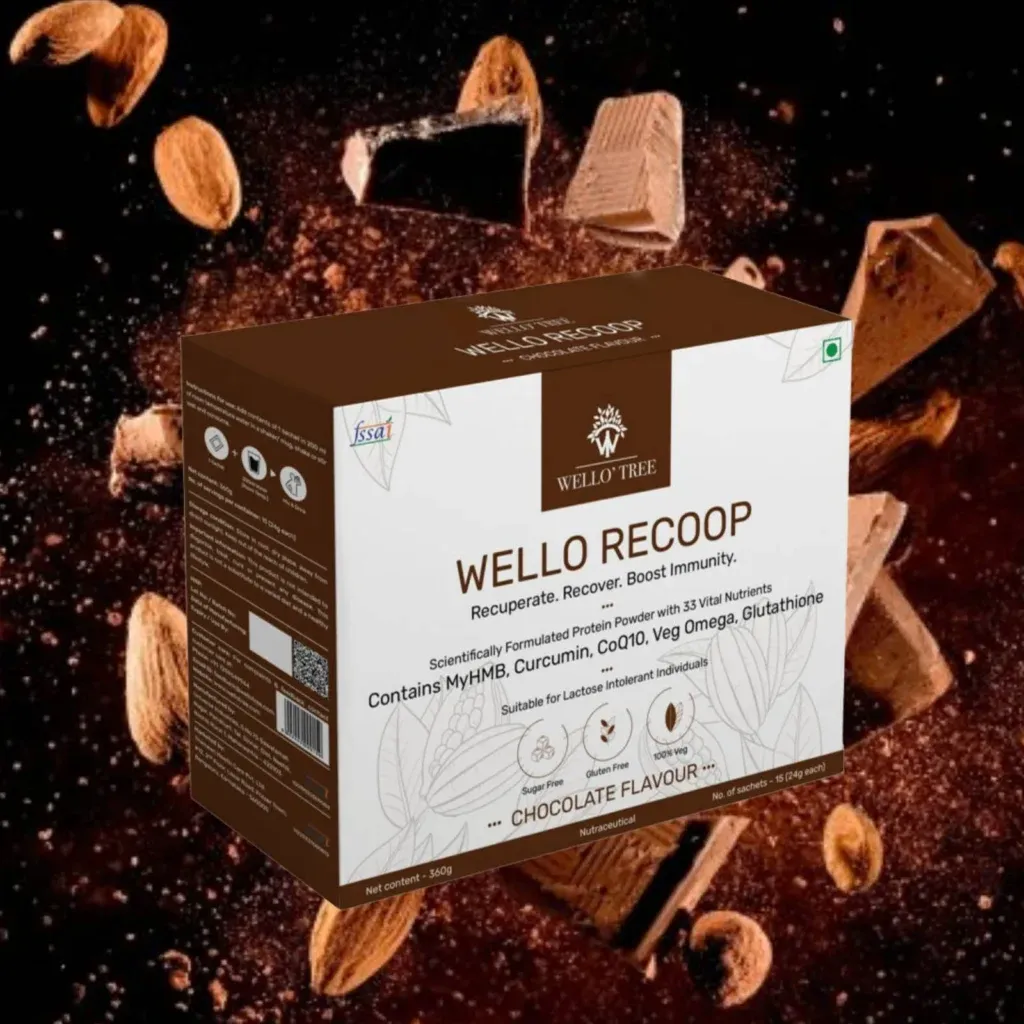
Wello Recoop is a diabetic-friendly, sugar-free recovery protein formulated with whey, pea, and brown rice protein plus HMB, CoQ10, curcumin, and probiotics.
What Happens to the Body in the First Six Weeks After Cardiac Surgery
The first thing worth understanding is the catabolic state that follows major surgery. The stress response — mediated by cortisol, glucagon, and inflammatory cytokines — drives protein breakdown across the body. In practical terms, the body starts dismantling skeletal muscle to meet its energy and amino acid demands. This is not a slow, quiet process. A patient who was ambulatory and functionally independent before surgery can lose meaningful muscle mass in the first two weeks post-discharge if nutritional intake is inadequate.
I operated on a 67-year-old man from Trichy last year — triple vessel disease, went through a CABG without complications — who came back at the six-week follow-up looking significantly weaker than when I had sent him home. His wife had been cooking him gentle, low-oil meals faithfully. The problem was that his protein intake was probably 30-35 grams per day, roughly half of what his recovering body needed. He had lost visible muscle from his arms and shoulders. His wound had healed, his echo looked reasonable, but the man could barely climb his own staircase.
That story is not unusual. It is in fact the norm.
The Protein Requirement Is Higher Than Most Patients Expect
The ICMR recommends approximately 0.8-1.0 g of protein per kilogram of body weight per day for healthy adults. For post-surgical patients, especially those over 60, current clinical evidence supports closer to 1.2-1.5 g/kg/day during the recovery phase. For a 70 kg patient, that is 84-105 grams of protein daily — from a body whose appetite has been suppressed, whose gut may be recovering from anaesthesia-related sluggishness, and whose family has been told to keep things light.
The Indian vegetarian diet can theoretically provide this. Lentils, paneer, curd, eggs if the patient eats them, soya — these are genuine protein sources. The challenge is volume and concentration. A bowl of moong dal at 30 grams cooked gives perhaps 7-9 grams of protein. You need multiple servings across multiple meals, at a time when appetite is low and fatigue makes eating effortful.
This is a real gap, and it is worth naming rather than dancing around.
Micronutrients That Cardiac Patients Are Commonly Deficient In
Beyond protein, there are specific micronutrients that matter disproportionately in post-cardiac recovery. Zinc is essential for wound healing; most patients have borderline zinc status going into surgery and the stress of the procedure depletes it further. Vitamin C supports collagen synthesis — sternal healing specifically depends on adequate collagen. Magnesium, which the heart muscle needs for proper electrical conductivity, is often low post-bypass because of the diuretics and fluid shifts involved. Coenzyme Q10 (CoQ10) levels drop significantly in the weeks following cardiac surgery, and there is reasonable clinical evidence linking CoQ10 repletion to improved cardiac function and reduced fatigue during recovery.
None of this is addressed on a standard discharge sheet. The sheet says low salt. It does not say “ensure zinc, ensure CoQ10, ensure protein.” Because those conversations take time that a post-cardiac ward discharging five patients a morning does not always have.
The Low Fat Advice: Useful, But Misunderstood
I want to defend the low fat advice partially, because there is a reason it exists. Saturated fat drives atherogenesis. A patient who has just had bypass surgery because of coronary artery disease has not had their underlying disease cured — the bypasses are conduits around blockages. The underlying atherosclerotic process continues, and dietary saturated fat remains relevant.
But the low fat message often gets translated at home into “avoid all fat” or “avoid all protein that might contain fat” — and that is counterproductive. Fish is not the enemy. Eggs are not the enemy. Nuts are not the enemy. Healthy fats — omega-3s in particular — are actually anti-inflammatory and beneficial in this recovery window. The cardiac diet, properly understood, is not about removing fat entirely but about the quality and type of fat. Whey vs Plant Protein for Recovery
Practical Nutrition Priorities for the First Eight Weeks Post-Discharge
Based on what I see in surgical recovery, these are the priorities I would give any cardiac surgery patient going home. Protein first — aim for a protein source at every meal, not just dinner. Small, frequent meals work better than three large ones when appetite is reduced. Hydration matters but should be calibrated to any fluid restriction your cardiologist has specified. Fibre is important because opioid-based pain relief causes constipation, which in turn causes straining — the last thing a sternotomy patient should be doing in week two.
Iron and B12 are relevant if the patient has had anaemia — which most cardiac surgery patients do by the time they leave hospital after days of operative blood loss and dilutional effects from bypass pump fluid. A clinical nutrition assessment at the one-week post-discharge mark would be ideal; in practice, most patients are not getting one.
Wello Recoop was specifically built with this kind of gap in mind — a recovery nutrition product rather than a fitness supplement, with protein, HMB for muscle preservation, CoQ10, glutathione for antioxidant support, and a broad micronutrient base. One or two sachets daily can meaningfully supplement what a reduced appetite at home cannot cover through food alone. Post-Surgery Diet Plan for Indian Patients
A Note on Diabetic Cardiac Patients
A significant proportion of cardiac surgery patients in India have concurrent Type 2 diabetes — the intersection of these two conditions is common. For these patients, the nutrition picture is more complex. Carbohydrate quality matters enormously. Post-surgical insulin resistance can worsen transiently, meaning blood glucose control becomes harder even with existing medication regimens. A high-carbohydrate recovery diet — the soft rice porridges and sweetened beverages that often get recommended — can make glycaemic control genuinely difficult in the first month.
For diabetic cardiac patients specifically, I would argue that protein adequacy is even more critical than for non-diabetic patients, because protein has a much smaller glycaemic impact than carbohydrate and preserves the muscle that insulin signalling depends on.
When to Seek a Formal Nutritional Assessment
If the patient is losing weight at home after surgery, seek a dietitian review. If appetite has not improved by week three post-discharge, that warrants attention. If there are wound healing concerns — a sternal wound that seems slow to close, a donor site that is not consolidating — nutrition status should be on the differential, not just infection or technique.
Most cardiac surgery centres in India have dietitians available in-hospital. The gap is the post-discharge period, when patients go home and the dietary guidance becomes generic. Families are doing their best with what they have been told. They deserve more specific guidance than a low fat, low salt sheet.

Available in Chocolate and Mango flavours
FAQs
During the active recovery phase (first 6-8 weeks), most cardiac surgery patients need 1.2-1.5 grams of protein per kilogram of body weight daily. For a 70 kg patient, that is 84-105 grams per day — significantly more than a standard Indian vegetarian diet typically provides without deliberate planning.
Yes. Eggs (particularly egg whites, or whole eggs in moderation) and paneer are valuable protein sources for recovery. The cardiac diet restricts saturated fat from processed and fried foods — not all dietary protein. Your cardiologist or dietitian can advise on specific portion sizes based on your individual lipid profile.
CoQ10 levels drop significantly following cardiac surgery. Clinical evidence supports CoQ10 supplementation in post-cardiac recovery for improved energy metabolism and reduced fatigue. It is not a substitute for medical treatment but a supportive nutrient during the recovery phase.
Several factors converge: anaesthesia effects on gut motility, pain medications, the stress response itself, and in some cases depression or anxiety about the recovery process. Small, frequent, protein-dense meals are more manageable than conventional three-meal patterns for most post-cardiac patients in the first few weeks.
Ideally within the first week post-discharge. If that is not available, at minimum before the 4-week follow-up appointment. Weight loss at home, persistent poor appetite, poor wound healing, or blood sugar instability are all reasons to seek a clinical nutrition review sooner.




Leave a Reply
You must be logged in to post a comment.