



The whey versus plant protein debate has been running on fitness and wellness forums for years. It is a genuinely interesting question in some contexts. For recovery nutrition — specifically for adults recovering from surgery, illness, or significant physical decline — it is largely the wrong question.
The right question is: does the protein source provide all the essential amino acids in amounts sufficient to support muscle protein synthesis, and can the patient’s digestive system actually use it? Those two criteria, amino acid completeness and digestibility, tell you far more about a protein’s utility for recovery than the fact of its animal or plant origin.

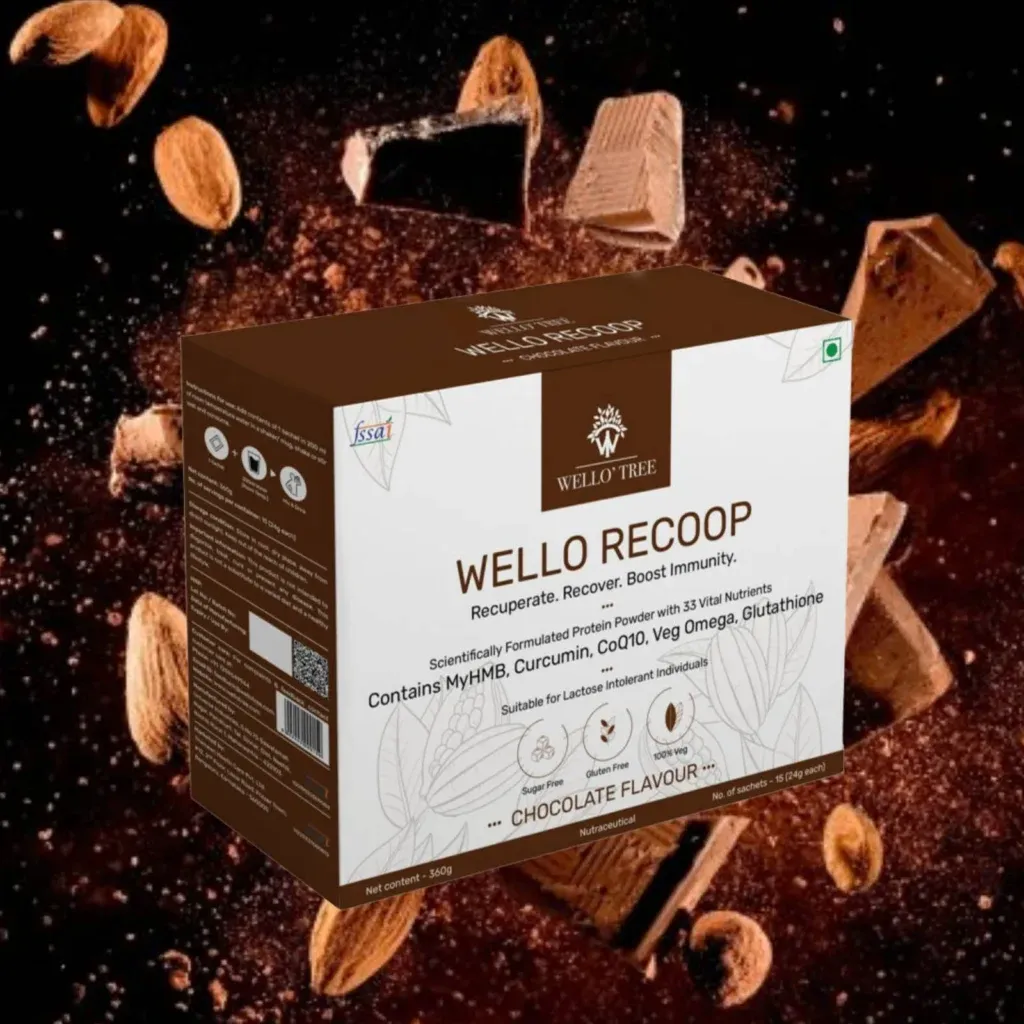
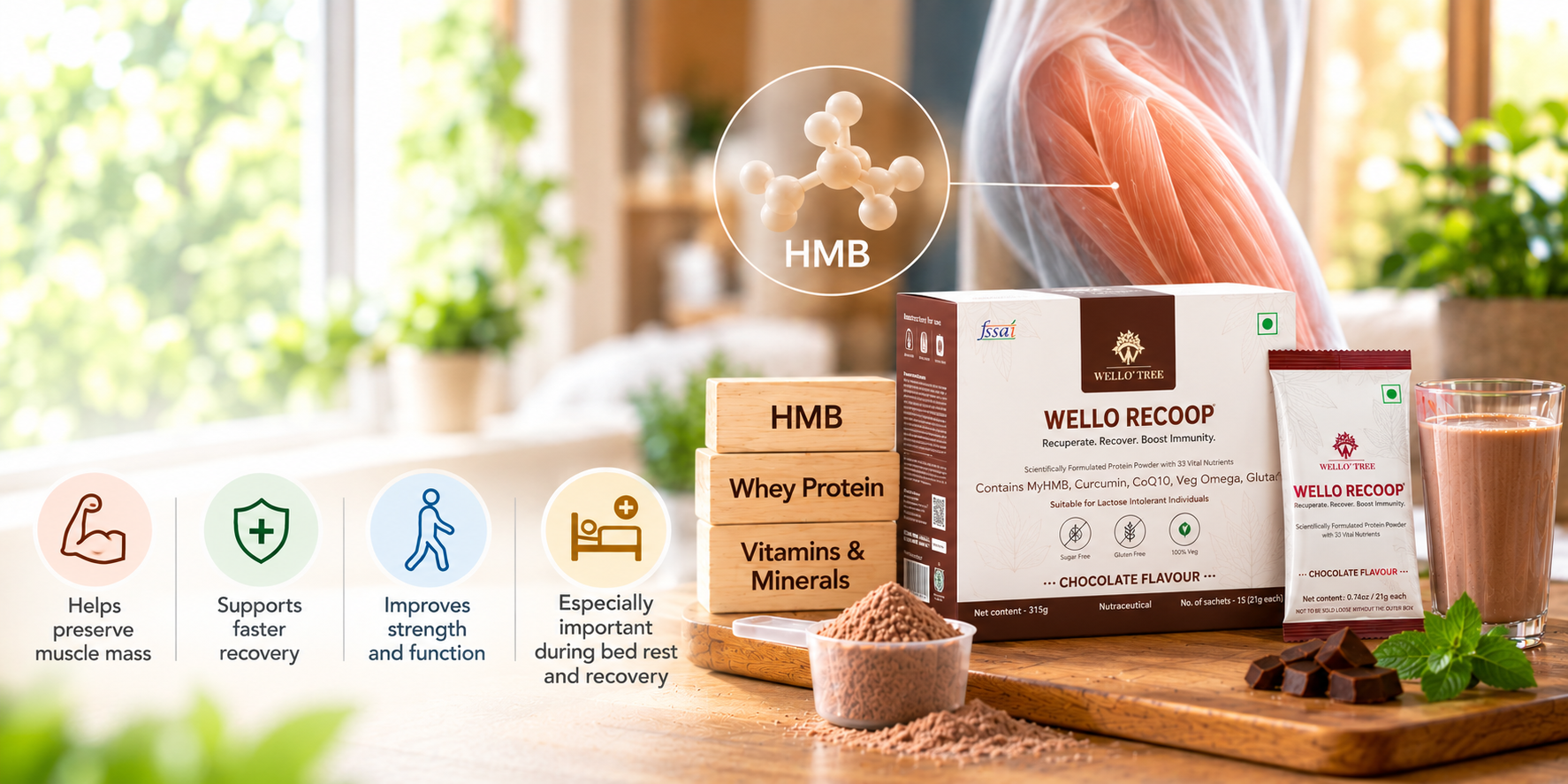
Wello Recoop is a diabetic-friendly, sugar-free recovery protein formulated with whey, pea, and brown rice protein plus HMB, CoQ10, curcumin, and probiotics.
What Makes a Protein Source “Complete” for Recovery
Protein quality is measured by several indices, the most clinically relevant of which is DIAAS — the Digestible Indispensable Amino Acid Score. It accounts for both the presence of essential amino acids and the extent to which they are absorbed from the gut. Whey protein scores exceptionally well on DIAAS. It is rich in leucine, the amino acid most directly responsible for triggering muscle protein synthesis, and it is highly digestible.
Most single-source plant proteins have lower DIAAS scores than whey — not because plant protein is inherently inferior, but because individual plant proteins have limiting amino acids that reduce their overall utility for muscle synthesis when used alone. Pea protein is high in arginine and branched-chain amino acids but low in methionine. Brown rice protein is relatively low in lysine. Soy protein is a notable exception — it has a more complete amino acid profile than most plant proteins and a good DIAAS score, though its absorption is slightly lower than whey.
This is where the combination approach resolves what the single-source approach cannot.
The Combination Argument: Why Pea and Rice Together Work
Pea protein and brown rice protein are complementary in their amino acid profiles in a specific way: pea protein’s limiting amino acid (methionine) is present in reasonable amounts in rice protein, and rice protein’s limiting amino acid (lysine) is well-represented in pea protein. Together, they produce an amino acid profile that is meaningfully closer to a complete protein than either is alone.
Several studies have now compared the combined pea and rice protein blend against whey in resistance-trained participants and have found comparable outcomes for muscle protein synthesis and recovery. This is not minor finding — it means a plant-based blend, appropriately formulated, can match whey’s functional performance for muscle support.
For Indian vegetarians who need effective recovery protein, this combination approach is clinically relevant. It means plant-based recovery nutrition does not have to be a compromise — it can be genuinely effective when the formulation is designed around amino acid complementarity rather than simply stacking a single plant protein source. Muscle Loss After Surgery
The Dairy Tolerance Dimension
Whey protein, particularly whey concentrate, contains lactose. For Indian adults — where lactase persistence rates are lower than in European populations, and where subclinical lactose intolerance is genuinely common — this is a practical consideration that often gets glossed over in supplement discussions.
Whey isolate (not concentrate) has significantly reduced lactose content, typically below 1% of the product weight, which is usually tolerable even for mildly lactose-intolerant individuals. But the point stands that a recovery supplement relying entirely on dairy-derived whey concentrate may cause digestive discomfort in a segment of the population that already has a sluggish, post-surgical gut. Bloating and diarrhoea are not good things in a recovering patient.
A formulation that combines whey isolate with plant proteins has the best of both: the leucine richness and high bioavailability of whey isolate, without the lactose load of concentrate, combined with the complementary plant amino acid profile and the tolerance advantages of non-dairy protein for sensitive patients.
Speed of Absorption: Does It Matter for Recovery?
Whey protein is often described as “fast-acting” compared to plant proteins, which is accurate — whey amino acids appear in the bloodstream more rapidly after ingestion. In the context of post-exercise recovery in athletes, this speed matters: getting amino acids to muscle tissue quickly in the post-exercise anabolic window has demonstrated benefits.
For post-surgical or elderly recovery patients, the picture is slightly different. The post-exercise anabolic window logic applies less directly when the “exercise” is a short daily walk and some physiotherapy rather than resistance training. What matters more is sustained amino acid availability across the day — which is where the combination approach again has an argument: different absorption rates from different protein sources mean a more sustained plasma amino acid profile compared to a single fast-absorbing protein alone.
I am not arguing that whey is inferior here. I am arguing that the absorption speed argument for whey in a recovery context is less definitive than it sounds when applied to athletes. Post-Surgery Diet Plan for Indian Patients
What This Means for Recovery Supplement Selection
For an Indian vegetarian recovering from surgery, or managing sarcopenia, or trying to maintain muscle health in their 60s and 70s, the optimal recovery protein is not simply “whey” or “plant.” It is a combination that covers the full amino acid spectrum, is digestible with a recovering gut, and is tolerated without discomfort.
Wello Recoop addresses this directly — the formulation combines whey isolate, pea protein, and brown rice protein to cover the full essential amino acid spectrum while managing lactose load and improving amino acid complementarity across sources. The design is not accidental: it reflects exactly the complementarity argument I have outlined above, applied specifically to Indian vegetarian patients in recovery contexts.
The single most important thing: whatever protein source is chosen, the total daily protein intake needs to be adequate. A philosophically perfect protein source consumed in insufficient quantity is less valuable than a mixed-source protein taken consistently in amounts that meet clinical targets.

Available in Chocolate and Mango flavours
FAQs
Whey protein has higher leucine content and bioavailability than most single-source plant proteins, making it marginally more efficient per gram for muscle protein synthesis. However, a combination of complementary plant proteins (pea and brown rice) produces an amino acid profile and muscle synthesis outcome comparable to whey in clinical studies. The combination approach closes most of the gap.
Yes, if the plant protein sources are strategically chosen and combined. Pea protein combined with brown rice protein covers the essential amino acid spectrum well. Soy protein is also a complete plant protein. Relying on a single plant protein source (pea alone, rice alone) leaves specific amino acid gaps that limit its utility for recovery. The combination matters.
Multiple studies comparing pea-and-rice protein blends against whey in recovery contexts have found comparable outcomes for muscle protein synthesis and lean mass outcomes. When formulated in appropriate proportions, the combination performs similarly to whey for recovery nutrition purposes.
Whey isolate — as distinct from whey concentrate — has very low lactose content (typically under 1%) and is generally tolerated by mildly lactose-intolerant individuals. Whey concentrate retains more lactose and may cause discomfort. For recovering patients with digestive sensitivity, choosing whey isolate or a whey isolate and plant protein combination is preferable to concentrate-based products.
A multi-source protein combining whey isolate (for leucine richness and high bioavailability), pea protein, and brown rice protein provides complete amino acid coverage with low lactose load and good digestibility. This combination is particularly well-suited to elderly Indian patients who may have digestive sensitivity and who benefit from a broad amino acid profile rather than a single source.




Leave a Reply
You must be logged in to post a comment.