




Families watching a parent or spouse come home from hospital are looking at the wound. They are watching for fever. They are managing medications and follow-up appointments. What almost no one is watching — because no one told them to — is muscle mass.
This is the silent half of surgical recovery, and by the time it becomes visible, a significant amount of damage has already been done.

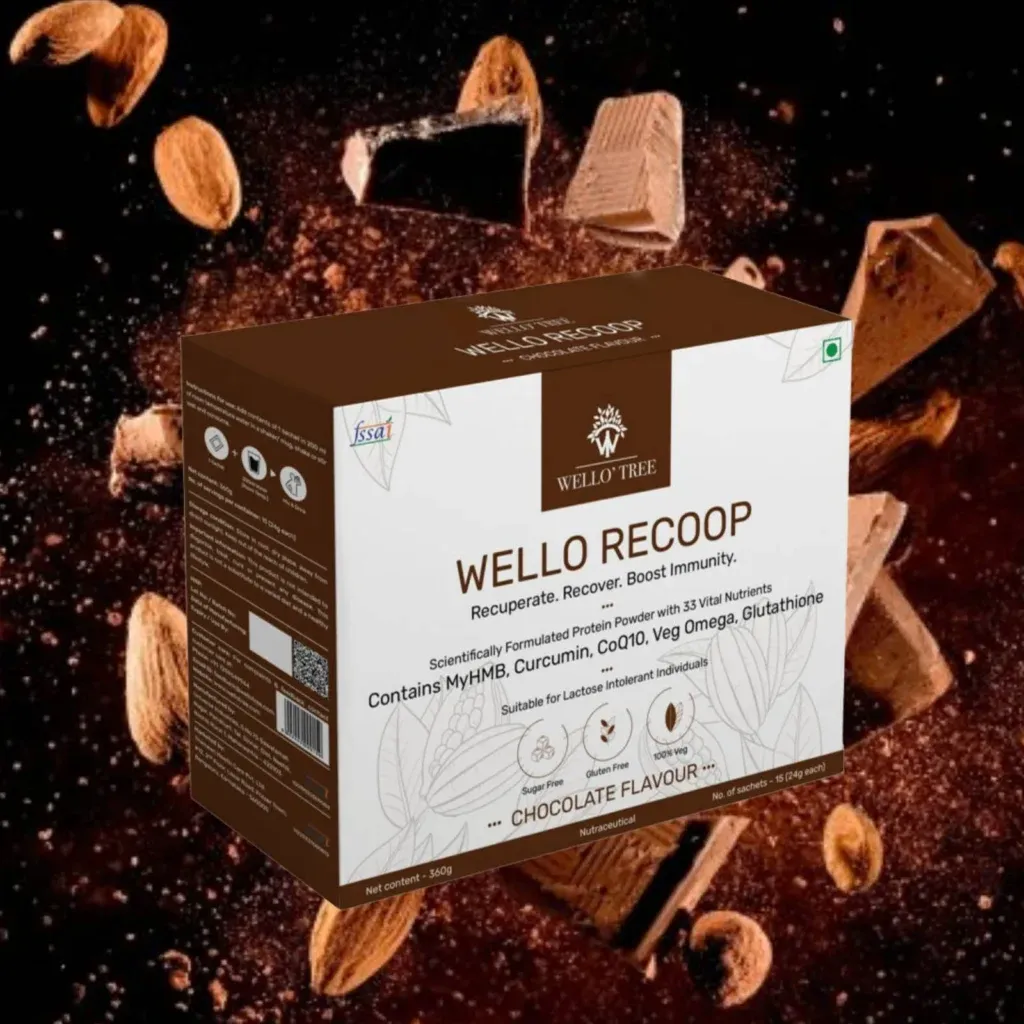
Wello Recoop is a diabetic-friendly, sugar-free recovery protein formulated with whey, pea, and brown rice protein plus HMB, CoQ10, curcumin, and probiotics.
The Numbers Are Stark
Bed rest and immobility cause skeletal muscle to break down at a rate that surprises most people when they first encounter it clinically. Studies have consistently found that complete bed rest leads to muscle protein loss of roughly 1-2% per day. A patient who spends ten days hospitalised — post-operatively, through an ICU stay, through step-down care — can lose 10-15% of their functional skeletal muscle mass before they even come home. In an elderly patient who was already on the lower end of muscle reserve going in, that loss can push them below the threshold for independent function.
A 72-year-old woman I followed through a hip replacement and complicated post-operative course spent 17 days in hospital. She went in walking unassisted with mild support. She came home needing a walker for activities she had managed without one for years. Her wound healed. Her implant was positioned correctly. But she was, clinically speaking, a different functional person. The surgery went well; the recovery of her muscle mass did not.
Her family thought she just needed time. They were partly right. But time without adequate nutrition is not recovery — it is slower decline.
Why Surgery Accelerates Muscle Breakdown
The surgical stress response is the starting point. Any major surgery — abdominal, orthopaedic, cardiac, thoracic — triggers a cascade of hormonal and inflammatory changes designed to mobilise resources for healing. Cortisol rises sharply. The body enters a catabolic state where protein synthesis is suppressed and protein breakdown is accelerated.
This is physiologically appropriate in the short term. The problem is that it continues well past the acute phase, and in the post-discharge period at home, where patients are not moving much and eating below their needs, the catabolic drive meets inadequate nutritional input. There is no protein coming in to replace what is being broken down. Muscle wasting continues.
Add to this the specific physiology of the elderly patient: with age, muscle protein synthesis becomes less sensitive to the anabolic signal of protein intake. Older adults need more protein than young adults to achieve the same muscle protein synthesis response — and they are going into surgery with less muscle reserve to begin with. The post-surgical window is not a minor nutritional concern for the elderly. It is a genuine medical risk.
What Families Notice — and What They Don’t
The visible signs of muscle loss — thinner arms, difficulty standing from a chair, slower gait — often get attributed to general “weakness from surgery” or to age. Families adjust: they help with stairs, they put a chair in the bathroom, they assume the person will gradually improve on their own. Some do. But a meaningful proportion do not recover the muscle they lost, particularly if the nutritional gap during the recovery window is not addressed.
What families almost never connect is the poor appetite in week one, the inadequate protein intake in weeks two through four, and the functional decline they see at the two-month mark. These are the same chain of events, separated by time.
The Role of HMB in Post-Surgical Muscle Preservation
HMB — beta-hydroxy beta-methylbutyrate — is a metabolite of the amino acid leucine. In the context of recovery nutrition, it has one specific and well-evidenced role: reducing the rate of muscle protein breakdown during catabolic states. This makes it particularly relevant in post-surgical recovery, where the catabolic drive is elevated and the ability to drive muscle synthesis through exercise is limited by immobility.
The clinical evidence for HMB is not as extensive as for protein and leucine broadly, but what exists is consistent: HMB supplementation in hospitalised and post-surgical patients is associated with better preservation of lean mass compared to protein alone. It is not a performance supplement. It is a preservation tool, and that distinction matters enormously for who benefits from it. Sarcopenia in Elderly Indians
Protein Timing Matters, Not Just Total Protein
One of the most consistent findings in recovery nutrition research is that protein distribution across the day matters as much as total daily protein intake. A pattern where someone eats most of their protein at dinner — common in Indian households, where the evening meal is typically the most substantial — means the body has large windows across the day where muscle protein synthesis rates drop due to insufficient amino acid availability.
Post-surgical patients, who are often not hungry in the morning and are managing nausea or fatigue through the day, are particularly vulnerable to this pattern. The clinical recommendation is to distribute protein more evenly — to have meaningful protein at each meal, not consolidated into one. This is harder than it sounds for families managing a recovering patient’s appetite, which is why a protein supplement that can be taken at any time of day regardless of appetite has practical utility.
Wello Recoop is designed exactly for this — not to replace meals but to fill the protein gaps between them, or to provide a meaningful protein contribution at times when the patient cannot eat enough to meet their needs through food alone.
Post-Surgery Diet Plan for Indian Patients
The Post-Discharge Window Is Critical and Widely Wasted
The first four to six weeks post-discharge represent a window where nutritional intervention has the highest impact. The body is still in active repair mode. The anabolic response to adequate protein is still accessible. Physical rehabilitation, even gentle walking and basic mobility, can begin converting nutritional support into muscle rebuilding.
Beyond the six-week mark, the catabolic phase typically moderates, but the muscle that was lost in the earlier window is now harder to recover — particularly in elderly patients whose anabolic sensitivity is already reduced. The window is not permanently closed, but it does narrow.
Practically, this means the conversation about nutrition should happen at discharge, not at the six-week follow-up. Most of it does not.
What a Recovery Nutrition Protocol Should Include
At minimum: protein at 1.2-1.5 g/kg/day, distributed across at least three intakes. Leucine-rich protein sources — whey, eggs, paneer, dals — to maximise muscle protein synthesis signal. HMB if available and appropriate. Zinc and vitamin C for wound healing. CoQ10 for cellular energy, especially in patients with cardiac or metabolic disease. Adequate calories to ensure protein is not being oxidised for energy rather than used for muscle repair.
This is achievable with a well-planned diet and targeted supplementation. What it requires is someone telling patients and families what to aim for, not just what to avoid.

Available in Chocolate and Mango flavours
FAQs
Research consistently shows that complete bed rest can cause muscle protein loss of 1-2% per day. A patient who spends 10-17 days in hospital can lose a significant proportion of their functional muscle mass before returning home. In elderly patients with low muscle reserve, this can push them below thresholds for independent function.
Yes, but the ease of recovery depends heavily on timing. The first four to six weeks post-discharge represent the highest-impact window for nutritional and rehabilitative intervention. Muscle loss that is not addressed in this period becomes progressively harder to reverse, especially in adults over 60.
HMB (beta-hydroxy beta-methylbutyrate) is a metabolite of leucine that helps reduce muscle protein breakdown during catabolic states. Clinical evidence supports its use in post-surgical and hospitalised patients to better preserve lean mass. It is most relevant during the recovery period when exercise is limited and the catabolic drive is elevated.
Elderly post-surgical patients typically require 1.2-1.5 g of protein per kilogram of body weight per day — significantly more than the standard recommendation for healthy adults. Their muscle protein synthesis response to protein is reduced with age, meaning higher intake is needed to achieve the same rebuilding effect.
Timing matters. Distributing protein intake across at least three meals provides a better muscle protein synthesis stimulus than consuming the same total amount concentrated in one or two meals. Post-surgical patients who eat poorly during the day and have their main protein at dinner are not fully utilising their protein intake for muscle repair.



Leave a Reply
You must be logged in to post a comment.