




If you ask any informed person in gym culture about protein supplementation, they will name whey, creatine, BCAAs. If you ask the same question to a geriatric medicine specialist or a post-surgical nutritionist, the compound they would add to that list is one most consumers have never encountered: HMB. Beta-hydroxy beta-methylbutyrate. A metabolite of the amino acid leucine, quietly accumulating clinical evidence for the past three decades, and almost entirely absent from the conversation outside research circles.
I want to explain what HMB is, what it actually does in the body, and why — in my clinical opinion — it belongs in the supplement plan of anyone over 50 who is recovering from illness or surgery, not in a gym-goer’s stack. The distinction matters because the mechanism is different from what the fitness market has led people to expect.

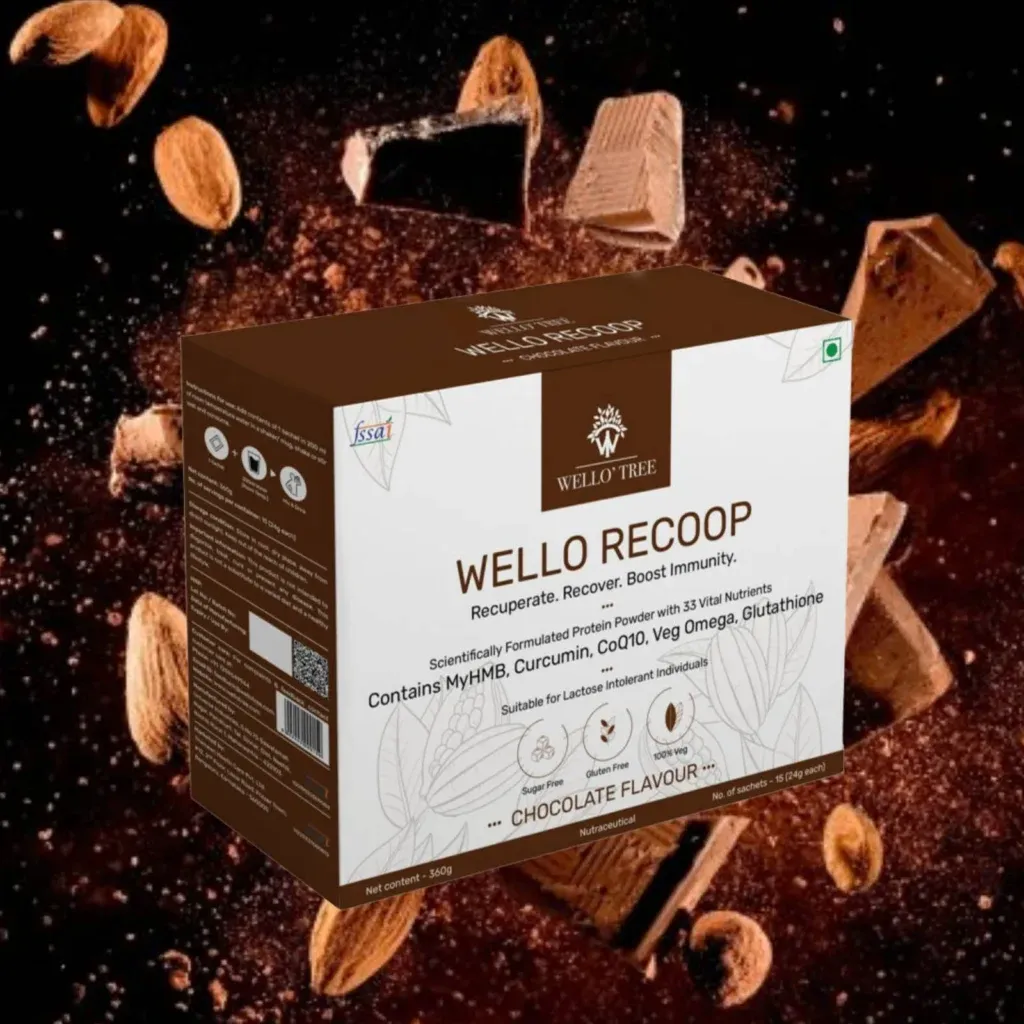
Wello Recoop is a diabetic-friendly, sugar-free recovery protein formulated with whey, pea, and brown rice protein plus HMB, CoQ10, curcumin, and probiotics.
What HMB Is and How It Is Made
HMB is produced naturally in the body as a metabolite of leucine. When dietary leucine is broken down, approximately 5% is converted to HMB. The rest is directed into protein synthesis or energy pathways. This means HMB is not a foreign compound — it is something the body already makes, in small quantities, every time it processes high-leucine foods like dairy, eggs, or meat.
The problem is the quantity. To produce a clinically effective dose of HMB from dietary sources alone, a person would need to consume approximately 600 grams of high-quality protein daily — a physiologically impossible target. HMB supplementation provides the body with the compound directly, bypassing the conversion bottleneck.
The clinically studied dose in most research is 3 grams per day, typically divided across two or three servings.
What HMB Actually Does — and Why It Is Different from Protein
This is the conceptual point that most people get wrong, because they conflate HMB with protein supplements in general.
Protein provides the substrate for muscle building. Amino acids from digested protein are used as raw material for new muscle protein. More protein means more raw material. This is the mechanism most people understand.
HMB does something fundamentally different. Its primary mechanism is the inhibition of the ubiquitin-proteasome pathway — the cellular machinery responsible for breaking down muscle protein. In other words, protein prevents muscle protein breakdown by giving the body enough raw material that it does not need to cannibalise existing muscle. HMB directly suppresses the breakdown signal itself.
In the technical literature, this is described as reducing muscle protein breakdown (MPB) rather than increasing muscle protein synthesis (MPS). Both matter for net muscle balance, but they are different levers. And during catabolic states — illness, surgery, prolonged bed rest, aggressive weight loss — the problem is almost always excessive breakdown, not insufficient synthesis. This is precisely the context where HMB has its most clinically significant effect.
The Clinical Evidence — What the Research Actually Shows
Post-surgical and critical illness populations
A landmark study published in Clinical Nutrition followed patients undergoing elective surgery and compared those receiving HMB supplementation against controls. The HMB group showed significantly reduced muscle protein breakdown markers and better retention of lean mass in the two-week post-operative period. This is not a small study from a fringe journal. Clinical Nutrition is one of the most cited journals in the field.
A Cochrane-adjacent systematic review of HMB in critically ill patients found consistent reductions in muscle wasting across the included trials. The effect size was modest but clinically meaningful in a population where even small amounts of preserved muscle mass translate to shorter ICU stays and faster functional recovery.
Elderly adults and sarcopenia
The strongest and most consistent evidence base for HMB is in elderly populations. A meta-analysis published in the Journal of Nutrition examined HMB supplementation across multiple trials in older adults and found significant improvements in lean mass and muscle strength compared to placebo, particularly in participants who were sedentary or recovering from illness.
The mechanism is relevant here: ageing muscle is in a state of chronic low-grade inflammation and accelerated protein turnover. The anabolic signals that would normally counterbalance this breakdown are blunted. HMB’s ability to directly suppress the breakdown pathway is particularly valuable when the body’s own anti-catabolic signalling is compromised. This is why HMB works better for elderly adults than it does for young, well-trained athletes with healthy anabolic signalling.
Comparison with the fitness supplement literature
In young, resistance-trained athletes with adequate protein intake and healthy anabolic hormonal status, HMB studies show modest and inconsistent results. Some show benefit, some show no significant effect over protein alone. The fitness community’s relative indifference to HMB largely reflects this literature.
But the population it was actually designed to benefit — elderly adults, post-surgical patients, people in catabolic stress — is a completely different physiological context. The compound is not less effective; it is being applied to the wrong population when it is positioned as a gym supplement. Its clinical utility is precisely in the contexts where gym supplements are almost never discussed.
Who Benefits Most from HMB
Based on the clinical evidence, the populations where HMB has the strongest documented benefit are: adults over 60 experiencing age-related muscle loss, patients in the four to six weeks following major surgery, adults recovering from any significant illness that involved bed rest or reduced appetite, and cancer patients undergoing treatment who have been advised by their oncology team to support lean mass.
The effect is additive to protein — it is not a replacement. A patient taking HMB without adequate protein intake does not see the same benefit as one where both variables are optimised. This is why the most evidence-backed approach is a formulation that combines quality protein with HMB rather than treating them as separate supplementation choices.
Why Wello Recoop Includes HMB
This is the clinical rationale behind including HMB in Wello Recoop, alongside whey isolate, pea, and brown rice protein. The population WelloTree was formulated for — adults over 50 recovering from surgery, hospitalisation, or illness — is precisely the population where the evidence for HMB is strongest and most consistent. A recovery nutrition formula without HMB addresses only the synthesis side of the muscle balance equation. Including HMB addresses the breakdown side simultaneously, which is where the largest deficit exists during the catabolic phase of recovery.
Formulating a product that contains both is not a marketing decision. It is the clinical answer to the physiological problem.
How to Know If HMB Is in What You Are Taking
HMB should appear on the ingredient list of a supplement by its full name (beta-hydroxy beta-methylbutyrate) or the common abbreviation HMB. Some products claim “muscle recovery support” or “anti-catabolic formula” on their front-of-pack without including HMB as a specific ingredient. The ingredient list is the only reliable source of truth. Look for it explicitly — not as part of a proprietary blend where the dose is undisclosed, but as a named ingredient with a declared amount.
The clinically studied dose is 3 grams daily. A product that declares HMB but does not state the amount, or that includes HMB as one component of a multi-ingredient blend with a collective dose listed, may not be delivering enough to produce the studied effect. Best Protein Powder for Recovery After Surgery in India

Available in Chocolate and Mango flavours
FAQs
HMB (beta-hydroxy beta-methylbutyrate) is a natural metabolite of the amino acid leucine. Its primary clinical function is to suppress the cellular pathway responsible for muscle protein breakdown — the ubiquitin-proteasome system. It does not primarily build muscle; it reduces the rate at which the body breaks it down, which makes it particularly valuable during illness, surgery, and ageing.
The strongest evidence for HMB is in elderly adults (over 60) experiencing muscle loss, post-surgical patients in the early recovery phase, and people recovering from illness or extended bed rest. The evidence in young, well-trained athletes is much weaker and inconsistent. HMB’s value lies specifically in catabolic and ageing contexts.
The dose used in clinical trials is typically 3 grams per day, divided across two or three servings. This amount cannot be realistically obtained from dietary leucine alone — the conversion rate is approximately 5%, which would require an impossible quantity of protein intake. Supplementation is necessary to achieve the studied dose.
No. HMB is a metabolite of leucine — it is produced from leucine during normal amino acid metabolism. Leucine itself triggers muscle protein synthesis. HMB specifically suppresses muscle protein breakdown. They have related but distinct mechanisms. Both are important; HMB cannot be substituted by simply taking more leucine, because the conversion rate from leucine to HMB is only about 5%.
HMB is additive to protein, not a replacement for it. Its mechanism (suppressing muscle breakdown) works alongside protein’s mechanism (providing raw material for muscle building). A patient with adequate protein and HMB sees better outcomes than one with either alone. A patient with HMB but inadequate protein still has a muscle building deficit; the breakdown side is addressed but the synthesis side is not.