




Type 2 diabetes management in India is overwhelmingly focused on what patients should not eat. Avoid rice. Limit sugar. Cut down on fruit. Reduce maida. This advice is not wrong, but it is dramatically incomplete. What most diabetic diet charts in India almost never contain is a protein target. And that absence has consequences.
I have been working with diabetic patients for over 20 years, and the pattern I see consistently is this: a patient successfully reduces carbohydrate intake, loses some weight, gets initial glucose improvement — and then plateaus. Sometimes their HbA1c inches back up over time even though they are still “following the diet.” When I do a dietary assessment, what I find is that they cut the rice and replaced it with more vegetable sabzi and two additional rotis. They reduced sugar but did not increase protein. Their muscle mass has been declining quietly for years.
That muscle loss is not incidental. It is mechanistically connected to their insulin resistance.

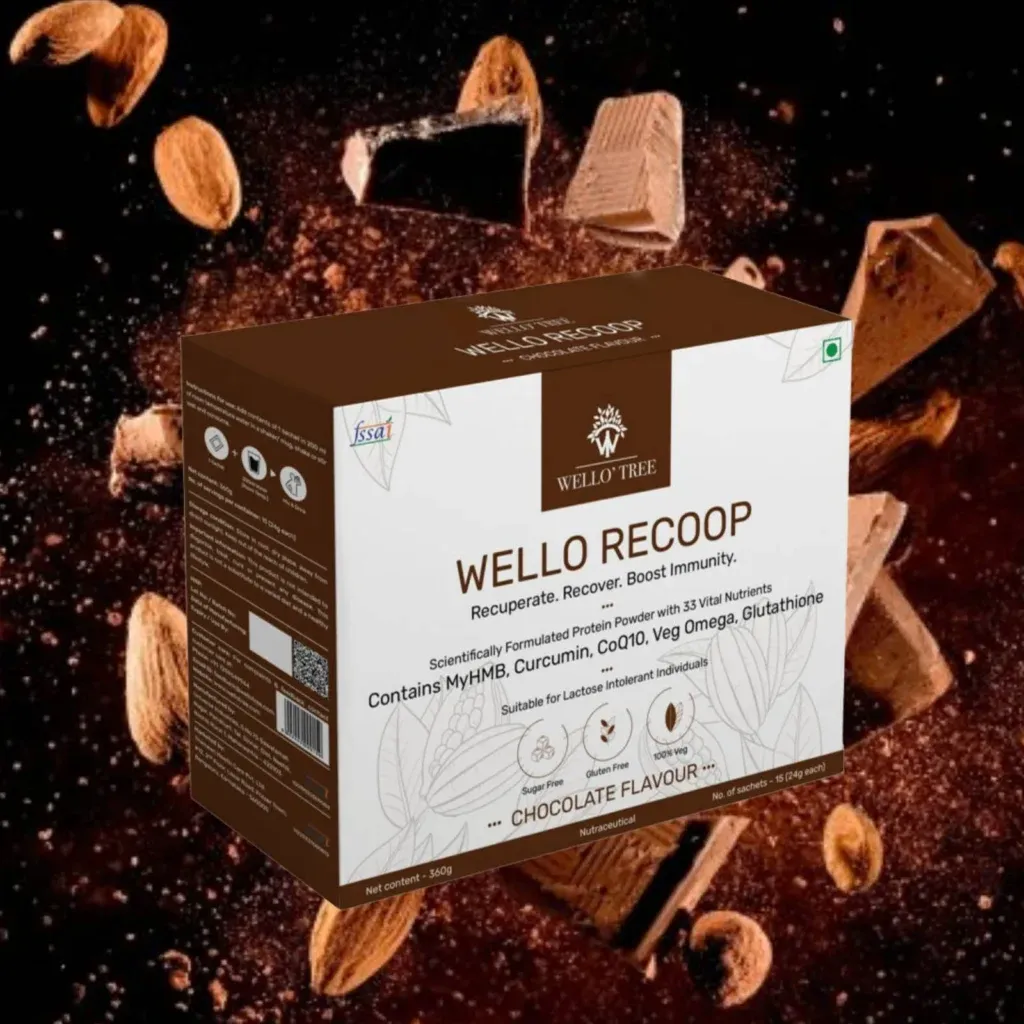
Wello Recoop is a diabetic-friendly, sugar-free recovery protein formulated with whey, pea, and brown rice protein plus HMB, CoQ10, curcumin, and probiotics.
The Muscle-Insulin Resistance Link That Most People Do Not Know About
Skeletal muscle is the primary site of insulin-mediated glucose uptake. After a meal, approximately 80% of the glucose in circulation is taken up by muscle tissue — when insulin is present and muscle is responsive. This is the fundamental mechanism of glucose disposal.
When muscle mass declines, that disposal capacity shrinks. A smaller muscle mass means less tissue available to absorb post-meal glucose. The result is higher post-meal blood glucose spikes, higher insulin demand, and over time a worsening of the insulin resistance itself. Sarcopenia — the progressive muscle loss that accelerates with age — is now understood to be not just a consequence of type 2 diabetes but an active driver of its progression.
The intervention implication is significant: preserving and supporting muscle mass in diabetic patients is not an aesthetic goal or a fitness goal. It is a glycaemic management strategy. And protein is the primary nutritional input for muscle maintenance.
Why the Standard Diabetic Diet Chart Is Insufficient
A typical diabetic diet chart issued by a physician or hospital dietitian in India will contain advice on carbohydrate restriction, fruit portions, oil quantities, and vegetable variety. It will sometimes list “lean protein” as something to include. What it will almost never contain is a specific daily protein target in grams per kilogram of body weight.
This matters because without a number, patients default to what they have always eaten — which is typically a carbohydrate-dominant Indian diet with protein as a supporting character rather than a defined component. They know they should eat protein, in the same vague way they know they should drink more water. It does not translate into behavioural change.
A 63-year-old patient of mine — a retired schoolteacher in Chennai, 58 kg, with type 2 diabetes for 11 years — came to me with rising HbA1c despite adherence to her carbohydrate-restricted diet. Her dietary history revealed approximately 35 grams of protein per day on average. Her target for muscle preservation should have been 70 to 85 grams. When we addressed the protein gap systematically over three months — increasing dal, adding curd with every meal, and supplementing with a protein sachet at breakfast — her muscle mass scores improved, and at the six-month follow-up her HbA1c had come down from 7.8 to 7.1. The medication had not changed.
How Much Protein Is Safe for Diabetic Patients?
The concern most people raise at this point is kidney function. And it is a legitimate concern — not to be dismissed. In patients with established diabetic nephropathy (kidney damage from diabetes), high protein intake can accelerate the disease. This is a real clinical boundary.
But it applies to patients with confirmed kidney disease, identified through kidney function tests (serum creatinine, eGFR, urine microalbumin). For the large majority of type 2 diabetic patients without nephropathy, the evidence does not support restricting protein intake below normal recommendations. The ESPEN guideline on diabetes and nutrition specifically states that protein intake of 1.0 to 1.5 grams per kilogram per day is appropriate for most patients with type 2 diabetes without kidney disease, and that protein does not need to be restricted.
This means that for a 60 kg diabetic adult without kidney disease, a protein target of 60 to 90 grams per day is clinically appropriate. It should be achieved through a combination of whole foods and, where dietary intake falls short, supplemental protein. What it should not contain is added sugar, maltodextrin, or artificial sweeteners — which rules out many commercial protein powders. Protein Powder for Diabetic Patients in India
Protein and Blood Glucose: What the Evidence Shows
A question I am asked frequently is whether protein spikes blood sugar. The short answer is: it depends on context.
Protein consumed alone raises glucagon more than insulin, which can result in modest glucose rises in some individuals. But protein consumed as part of a mixed meal — alongside carbohydrates and fats, which is how it is eaten in practice — actually reduces the glycaemic response of that meal. The protein slows gastric emptying, reduces the rate at which carbohydrates reach the small intestine, and moderates post-meal glucose rise.
Multiple studies have shown that increasing the protein proportion of a meal while reducing the carbohydrate proportion reduces the post-meal glucose area under the curve in people with type 2 diabetes. This is not a theoretical benefit. It is measurable on a continuous glucose monitor within a single meal.
Practical Protein Guidance for Diabetic Indian Adults
The goal is not to radically change the diet. It is to shift the protein proportion meaningfully at each meal while maintaining the food culture.
At breakfast: add an egg, a paneer slice, or a protein supplement if appetite is low. Move away from the biscuit-and-tea pattern. A breakfast with 20 to 25 grams of protein sets up glucose stability for the first half of the day in a way that an idli-sambar breakfast cannot.
At lunch: ensure a full katori of dal, and consider increasing paneer or curd servings. One hundred grams of paneer with lunch adds 18 to 20 grams of high-quality protein and is well-tolerated by most diabetic patients. It also has a low glycaemic index.
At dinner: similar approach — protein first, carbohydrate second. This sequencing of food within a meal — protein and vegetable before carbohydrate — has been shown to reduce post-meal glucose response meaningfully. It requires no change to what is eaten, only to the order.
Where dietary protein consistently falls short, a supplement like Wello Recoop fills the gap without adding sugar or glycaemic burden. It is formulated with no added sugar, making it suitable for diabetic patients who need protein support but cannot tolerate glucose-spiking ingredients common in many commercial products.

Available in Chocolate and Mango flavours
FAQs
For the majority of type 2 diabetic patients without kidney disease, a protein intake of 1.0 to 1.5 grams per kilogram per day is clinically appropriate and does not increase health risk. The ESPEN guideline on diabetes nutrition does not recommend protein restriction for diabetic patients without nephropathy. Kidney function should be confirmed before significantly increasing protein.
Protein consumed as part of a mixed meal actually reduces the glycaemic response by slowing gastric emptying and moderating glucose absorption. Protein consumed alone may cause modest glucose rises in some individuals. In practical meal contexts, higher protein meals are associated with better post-meal glucose control than carbohydrate-dominant meals.
Skeletal muscle is the primary site of post-meal glucose uptake. As muscle mass declines — which happens progressively with age and is accelerated by diabetes — the capacity to absorb and dispose of post-meal glucose shrinks. This drives higher blood glucose and worsening insulin resistance. Preserving muscle through adequate protein intake is a glycaemic management strategy, not just a fitness goal.
Paneer (low glycaemic index, 18 to 20 grams protein per 100 grams), curd, eggs, moong dal, rajma, chana, tofu, and soy chunks are the best whole-food options. For supplemental support, a no-added-sugar protein powder formulated for diabetic patients is appropriate. Avoid products containing maltodextrin, glucose syrup, or sucralose.
Patients with confirmed diabetic nephropathy (kidney damage) need to restrict protein and should follow the guidance of their nephrologist and dietitian. However, this applies to patients with established kidney disease, not all diabetic patients. Kidney function tests (eGFR, serum creatinine, urine microalbumin) are necessary before making this determination.





Leave a Reply
You must be logged in to post a comment.