



Every year I see hundreds of patients over 60 in clinical practice, and almost none of them know their protein target. They know their blood sugar target. They know their blood pressure number. But protein? They tell me they “eat dal regularly” and assume that is the end of the conversation.
It is not. And the reason it gets so little attention is partly systemic. The protein recommendation most Indian families reference — when they reference it at all — is the ICMR Recommended Dietary Allowance. That figure is 0.8 grams of protein per kilogram of body weight per day. What most people do not know is that this figure was determined for a reference healthy Indian adult in their mid-twenties, in energy balance, with no illness or physiological stress.
An elderly Indian adult — over 60, with reduced digestive efficiency, lower food intake, and higher risk of muscle loss — is physiologically a completely different person. Applying the same protein recommendation to both is like using a children’s medication dose for an adult because both are human.

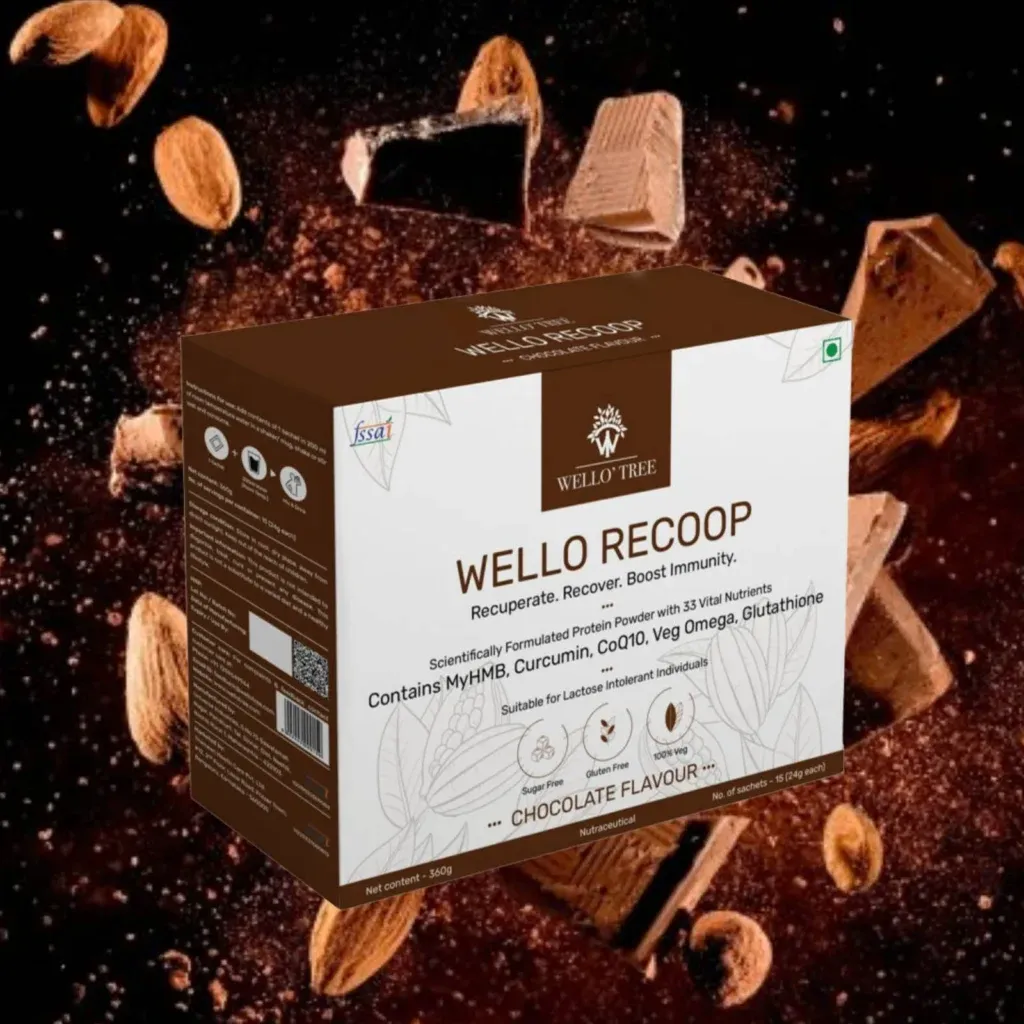
Wello Recoop is a diabetic-friendly, sugar-free recovery protein formulated with whey, pea, and brown rice protein plus HMB, CoQ10, curcumin, and probiotics.
Why Elderly Adults Need More Protein, Not Less
There is a phenomenon called anabolic resistance that begins somewhere in the fifth decade and accelerates with age. It means that the ageing muscle requires more protein stimulus — specifically more leucine per meal — to achieve the same rate of muscle protein synthesis that a younger person would achieve from a smaller amount.
A 30-year-old can trigger a meaningful muscle protein synthesis response with 20 grams of quality protein per meal. The evidence suggests a 65-year-old needs 35 to 40 grams per meal to achieve the same result. Not because the body is broken — but because the signalling thresholds have changed. This is not a disease. It is physiology. But it means the protein targets need to shift upward, not stay flat.
At the same time, total food intake typically decreases with age. Appetite falls. Gastric emptying slows, creating a feeling of fullness on less food. Taste and smell change, reducing the appeal of food. The result is that elderly adults need more protein per kilogram, but are eating less food overall. The maths do not work in their favour without deliberate intervention.
What the Evidence Actually Recommends
The European Society for Clinical Nutrition and Metabolism (ESPEN) recommends 1.0 to 1.2 grams of protein per kilogram per day for healthy elderly adults, and 1.2 to 1.5 grams per kilogram for those with acute or chronic illness. The Protein Summit consensus, which brought together protein researchers from multiple countries, suggested that even the ESPEN figure might be conservative for elderly adults.
For a 60 kg Indian woman of 68, the standard ICMR recommendation gives a daily protein target of 48 grams. The ESPEN recommendation gives 60 to 72 grams. For someone with a recent illness or recovering from a fall — 72 to 90 grams. The gap between 48 and 72 grams is the gap between what the policy says and what the physiology requires.
Doing the Maths with Real Indian Meals
Let me show what a typical day looks like, because abstract numbers are less useful than a worked example.
Breakfast
Two idlis with sambar and a small cup of filter coffee with milk. Approximate protein: 6 to 8 grams. The idlis are primarily carbohydrate (rice and urad dal in roughly 3:1 ratio). The sambar adds a few grams. The coffee adds 2 to 3 grams from milk.
Lunch
Two rotis, a katori of dal (toor or moong), a sabzi, and a small bowl of curd. Approximate protein: 15 to 18 grams. The dal contributes perhaps 7 to 8 grams in a katori serve. The rotis add 5 to 6 grams. The curd adds 3 to 4 grams. The sabzi is typically negligible.
Evening snack
Tea with two biscuits. Approximate protein: 2 to 3 grams.
Dinner
Two rotis, a small bowl of sabzi, occasional dal or rajma. Approximate protein: 12 to 15 grams.
Total for the day: approximately 35 to 44 grams of protein. Against a target of 60 to 72 grams for a healthy 68-year-old woman at 60 kg, this diet delivers somewhere between 50% and 70% of what the evidence says she needs. This is not unusual. This is a standard, reasonable, middle-class Indian vegetarian diet.
Where the Gaps Are Largest
Breakfast is the most protein-deficient meal in most Indian elderly diets. The traditional South Indian or North Indian breakfast is carbohydrate-dominant — idli, dosa, poha, upma, paratha. These are not nutritionally poor foods. They are energy-appropriate and easy to digest. But they deliver minimal protein, and breakfast is exactly the meal where protein matters most for initiating muscle protein synthesis after the overnight fasting period.
A practical intervention that I often suggest: add one or two eggs to breakfast (for those who eat eggs), or a small serving of paneer, or a protein-enriched supplement taken with the morning meal. This single change, applied consistently, can close 30 to 40% of the daily protein gap without requiring major dietary restructuring.
The other significant gap is the evening snack, which in most elderly households is tea and biscuits or tea and namkeen — a meal that provides perhaps 3 grams of protein at best. Replacing this with a curd-based snack or a small serve of protein supplement closes another meaningful portion of the gap.
The Vegetarian Protein Paradox
The Indian vegetarian diet is often assumed to be protein-adequate because it includes dal, paneer, and curd — all legitimate protein sources. The issue is protein quality as much as quantity.
Most plant proteins are incomplete — they lack one or more essential amino acids in adequate amounts. Dal is low in methionine. Rice is low in lysine. The traditional Indian combination of dal and rice is better together than either is alone, but the combination still falls short of the amino acid profile of animal proteins, particularly for the elderly whose absorption efficiency is already reduced.
Whey protein — derived from dairy, which is acceptable in a vegetarian Indian diet — has the highest biological value of any protein source and is particularly high in leucine. Including a small amount of whey as part of the diet, whether from paneer, curd, or a quality supplement, meaningfully improves the usable protein that reaches ageing muscle.
Wello Recoop uses this logic explicitly: it combines whey isolate with pea and brown rice protein not to be different, but because the combination addresses amino acid gaps that any single source leaves open. For an elderly Indian vegetarian who is already eating dal and curd, a single sachet of Wello Recoop provides a complementary amino acid contribution rather than a redundant one. Signs of Protein Deficiency in the Elderly
A Practical Starting Point
If you are over 60 and reading this, here is a simple calculation. Take your body weight in kilograms and multiply by 1.0. That is your minimum daily protein target in grams. Multiply by 1.2 if you have had any illness in the past year, any period of reduced activity, or if you have noticed any of the signs of muscle loss. Now add up what your current typical day provides using the examples above. If the gap is more than 20 grams, which it likely is, that gap is worth closing.
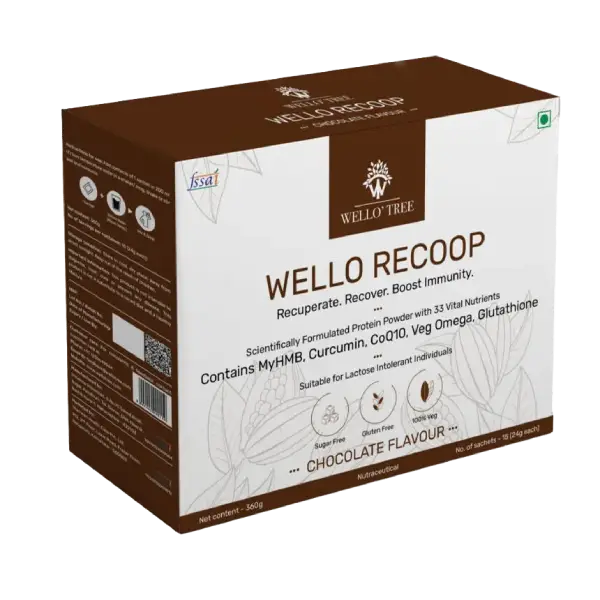
Available in Chocolate and Mango flavours
FAQs
The current evidence-based recommendation for healthy elderly adults is 1.0 to 1.2 grams of protein per kilogram of body weight per day — higher than the ICMR general adult RDA of 0.8 grams per kilogram. For a 60 kg elderly person, this is 60 to 72 grams per day. During illness or recovery, the target rises to 1.2 to 1.5 grams per kilogram.
The ICMR RDA of 0.8 grams per kilogram was established for young healthy adults. Current geriatric nutrition science indicates this is insufficient for adults over 60, particularly those with reduced appetite, illness history, or muscle loss. International guidelines recommend significantly higher amounts.
Paneer (18 to 20 grams per 100 grams), curd (4 to 5 grams per 100 ml), moong dal (7 to 8 grams per katori), rajma and chana (8 to 9 grams per katori), and soy products are the best whole-food sources. For closing the gap between diet and target, a quality whey or blended protein supplement provides a high-quality, easy-to-absorb addition.
Anabolic resistance — the reduced sensitivity of ageing muscle to protein stimulus — means that elderly adults require more protein per meal to trigger the same muscle-building response as a younger person. Additionally, reduced appetite and digestive efficiency mean less total protein is consumed and absorbed. Both factors together create progressive muscle loss even on diets that appear adequate.
Unlikely, for most people. A standard dal-curd meal contributes approximately 10 to 12 grams of protein. Meeting a daily target of 60 to 72 grams requires this quality across every meal — which is achievable but requires deliberate planning and often supplemental support to manage on reduced appetite.