



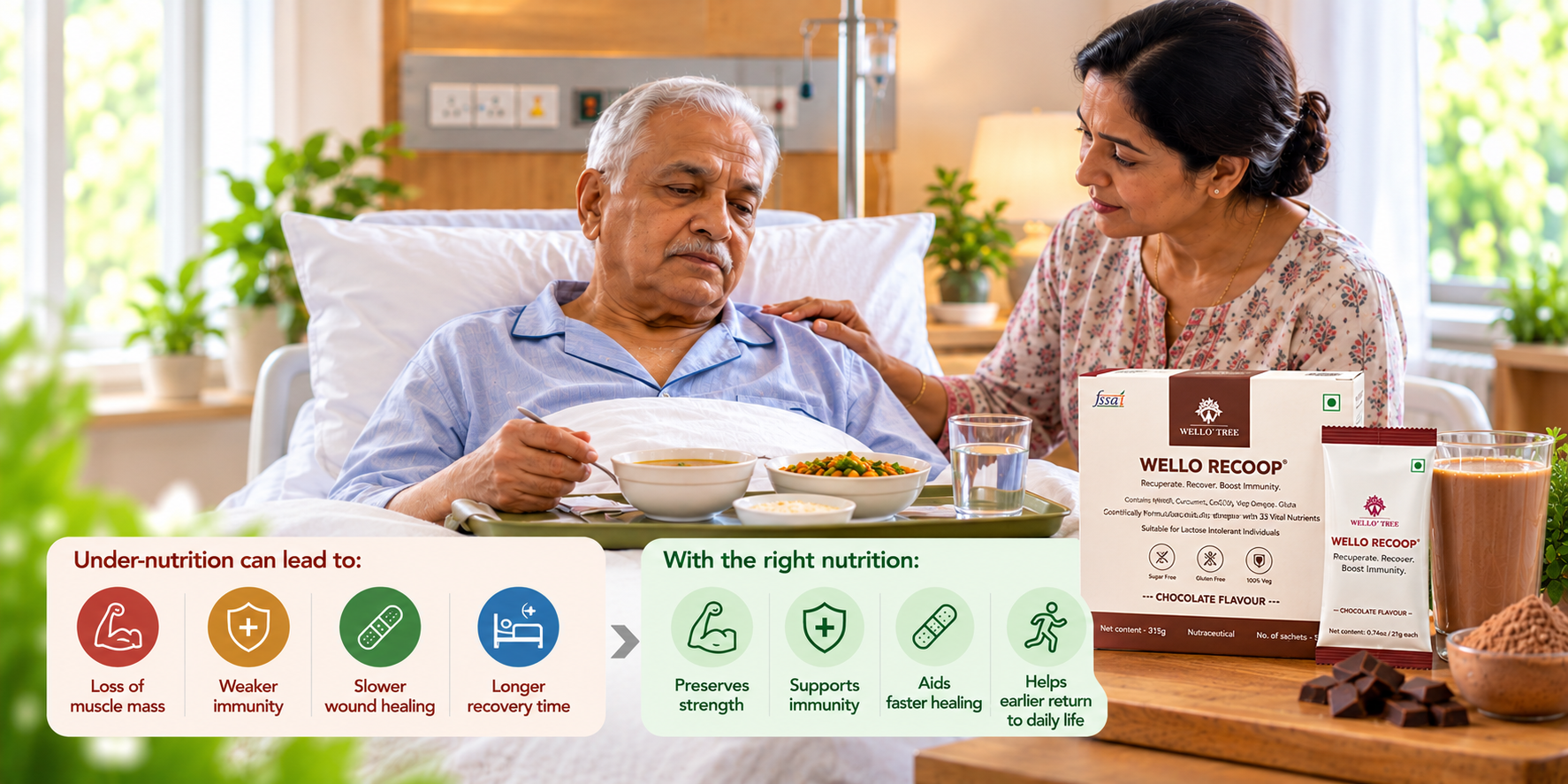
Knee replacement is one of the most performed orthopaedic procedures in India, and the number is rising every year as the population ages. Most patients come out of surgery with a physiotherapy schedule, a list of exercises, and instructions on when to bear weight. What they rarely leave with is a nutrition plan — and that gap quietly shapes how well the recovery actually goes.
The first six weeks after knee replacement surgery are not just about learning to walk again. At a cellular level, your body is simultaneously trying to close the wound, rebuild the peri-articular muscles that were cut or stretched during surgery, and lay down new collagen around the prosthetic joint. All three processes pull from the same protein pool.

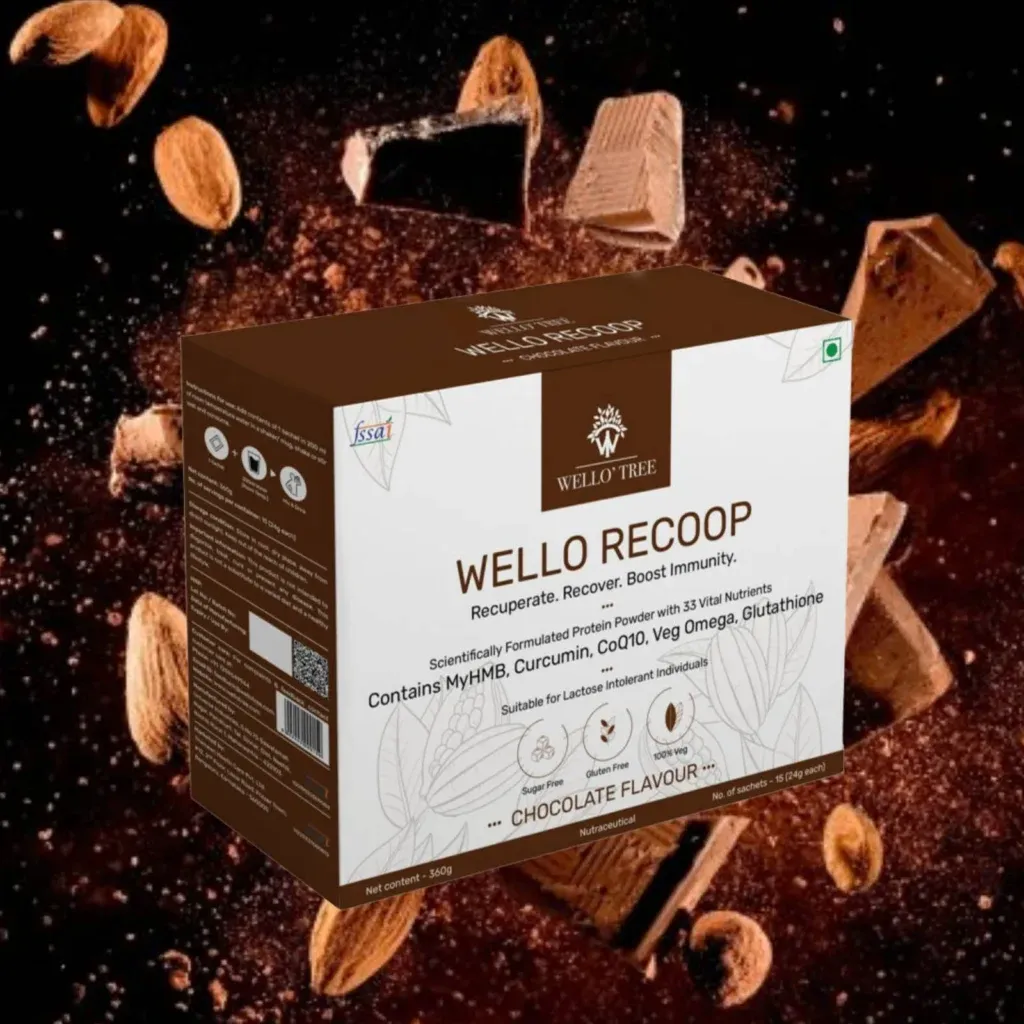
Wello Recoop is a diabetic-friendly, sugar-free recovery protein formulated with whey, pea, and brown rice protein plus HMB, CoQ10, curcumin, and probiotics.
Why Protein Demand Spikes After Knee Surgery
Post-surgical protein requirements are not what most patients or even caregivers expect. The body enters a catabolic state immediately after any major surgery — cortisol and inflammatory cytokines rise, and muscle protein begins breaking down faster than it is being built. In a young, well-nourished person, this resolves relatively quickly. In someone who is 60 or older, or who was already eating less than optimal protein before surgery, the body may not have enough reserves to sustain the healing demand without pulling from existing muscle tissue.
ICMR guidelines suggest 0.8–1g of protein per kg of body weight per day for healthy older adults. After surgery, that target moves to 1.2–1.5g per kg — sometimes higher if there is significant tissue trauma. For a 65kg woman recovering from bilateral knee replacement at a Chennai hospital, that is 85–100g of protein daily. A bowl of dal, two rotis, and curd will not get her there.
This is not a theoretical concern. Patients who enter surgery with low muscle mass, what clinicians now call sarcopenia, have measurably worse post-surgical outcomes: longer hospital stays, slower functional recovery, and higher rates of complications. Protein intake before and after surgery is a modifiable factor. Most families are not told this.
Collagen Is Not a Beauty Supplement in This Context
There has been a lot of marketing noise around collagen supplements for skin and joint health. Set that aside for a moment. After knee replacement, collagen synthesis is a structural necessity — the capsule around the new joint, the scar tissue that will eventually stabilise it, and the tendons and ligaments adapting to new mechanics all require collagen as raw material.
The key amino acids for collagen synthesis are glycine, proline, and hydroxyproline. Vitamin C is the essential cofactor — without adequate Vitamin C, collagen crosslinking is impaired regardless of how much protein the patient is eating. Many older Indian adults run chronically low on Vitamin C simply because cooked vegetables lose a significant portion of it in preparation.
Zinc matters too. It is rate-limiting for cellular proliferation during wound healing and is almost never discussed in discharge instructions. The average Indian vegetarian diet provides around 8–10mg of zinc daily against a requirement that climbs to 12–15mg post-surgically. A patient eating only dal, rice, and sabzi is likely short on zinc every day of their recovery.
The Muscle Rebuilding Problem
Physiotherapy after knee replacement is designed to restore range of motion and rebuild quadriceps strength. The exercises are real work. What they are not, by themselves, is sufficient to rebuild muscle. Resistance exercise stimulates muscle protein synthesis — but synthesis requires substrate. Without adequate leucine-rich protein intake around the time of physical therapy sessions, the stimulus from exercise is essentially wasted.
Leucine is the branching-chain amino acid that acts as the primary trigger for muscle protein synthesis. It is found in meaningful quantities in whey protein, eggs, paneer, and legumes — though plant sources require larger quantities to deliver equivalent leucine loads. A patient who has their physiotherapy session at 10am and then eats a light lunch of idli and sambar two hours later has missed the anabolic window almost entirely.
Timing matters more than most people think. Distributing protein across three to four meals — rather than concentrating it in one large dinner, which is common in Indian households — improves muscle protein synthesis rates, particularly in older adults.
Practical Guidance for the 6-Week Recovery Period
The goal is not to completely overhaul the patient’s diet. The goal is to close the specific gaps that knee replacement creates. Some practical guidance:
Breakfast should carry protein. A South Indian breakfast of idli and sambar is pleasant and easy to digest, but adding two eggs or a glass of milk with a protein supplement shifts the nutritional profile substantially. In North Indian households, a paratha with paneer or an egg bhurji is a stronger recovery breakfast than plain toast and chai.
Dal at every lunch and dinner is a reasonable baseline, but the quantity matters — a small katori of dal provides roughly 5–7g of protein. Getting to a recovery-level protein target requires either much larger portions of dal or supplementing with concentrated protein sources. Rajma, chana, and moong are better than toor in terms of protein density per serving.
Curd and paneer are underutilised protein sources in post-surgical Indian diets, partly because patients fear dairy will cause “acidity” or “inflammation.” In the absence of a clinical contraindication, these fears are not well-supported. A 100g serving of paneer provides roughly 18–20g of protein and is easily digestible.
Wello Recoop was specifically designed for scenarios like post-knee-replacement recovery — 33 nutrients in a single sachet, including HMB to reduce muscle protein breakdown, Vitamin C, zinc, and glutathione alongside a whey isolate and plant protein blend. For a patient who has poor appetite after surgery (extremely common in the first two weeks), adding one sachet to a small glass of milk or water gives 15–20g of high-quality protein without requiring a large meal. What Is HMB and Why It Matters After 50
Hydration and Micronutrient Support
Knee replacement patients are often poorly hydrated post-surgically, partly due to pain medication side effects and reduced mobility. Mild dehydration impairs wound healing and can contribute to constipation, which strains the body and distracts from recovery. Two litres of fluid daily is a reasonable baseline. Coconut water, diluted buttermilk (chaas), and lime water are culturally familiar options.
Iron deserves attention if there was significant blood loss during surgery. A haemoglobin check at the two-week mark is sensible. If iron is low, the patient should not wait for it to “correct itself” — tissue oxygenation matters for healing, and anaemia extends recovery timelines.
What the Evidence Says
A 2021 meta-analysis in Clinical Nutrition found that oral nutritional supplementation in orthopaedic patients reduced complication rates and length of hospital stay. The effect was stronger in malnourished patients but was present even in patients classified as adequately nourished. The implication is that routine post-surgical nutritional support — rather than waiting for malnutrition to declare itself — produces better outcomes.
The data on leucine-enriched protein supplements specifically for post-surgical recovery shows consistent benefit for muscle mass preservation and functional recovery speed. This is not experimental. It is well-established in sports medicine, geriatric medicine, and increasingly in orthopaedic surgery literature.

Available in Chocolate and Mango flavours
FAQs
Most clinical guidelines for post-surgical adults suggest 1.2 to 1.5g of protein per kilogram of body weight per day during the acute recovery phase (the first 4–6 weeks). For a 65kg adult, this is 78 to 97g of protein daily — significantly more than the typical Indian diet provides. Work with a dietitian to calculate the specific target based on body weight, surgical complexity, and any co-existing conditions like diabetes or kidney disease.
Yes, paneer is an excellent protein source for post-surgical recovery in vegetarian patients. It provides roughly 18–20g of protein per 100g serving, is rich in calcium, and is generally well-tolerated. The concern about paneer causing inflammation is not supported by evidence in otherwise healthy gastrointestinal conditions. Patients with lactose intolerance may need to trial it carefully.
Most surgeons initiate some form of physiotherapy within 24–48 hours of surgery, even if it is just gentle knee bends and ankle pumps. Weight bearing typically begins on day one with assistance. Active rehabilitation usually continues for 3–6 months, with the first 6 weeks being the most intensive. Nutrition should be addressed in parallel with physiotherapy, not after.
Food-grade protein supplements are generally safe and often clinically indicated after major orthopaedic surgery, particularly for elderly patients or those with poor appetite. The key considerations are: ensure the supplement is manufactured under GMP conditions (FSSAI, WHO GMP certified), confirm it does not contain added sugar if the patient is diabetic, and check it does not interact with any medications. Consult the treating surgeon or a dietitian before starting any supplement.
Yes. Vitamin C is an essential cofactor in collagen synthesis — without it, the enzyme prolyl hydroxylase cannot convert proline to hydroxyproline, a structural component of collagen. Deficiency causes impaired wound healing, and even sub-clinical insufficiency (below 50 micromol/L in serum) slows collagen deposition. Most Indian diets provide adequate Vitamin C if fresh fruits and raw vegetables are consumed regularly, but cooking destroys a significant portion. A supplement providing 40–80mg of Vitamin C daily during the recovery period is a reasonable precaution.




Leave a Reply
You must be logged in to post a comment.